

Deciding whether to repair or replace your solar system depends on your system’s age, the specific fault, and the cost-effectiveness of the solution. If your system is relatively new and has a minor, isolated issue like a single damaged panel, a repair is often the most sensible path.
However, if your system is over a decade old, significantly undersized for your needs, or facing a major component failure like a dead inverter, a full replacement is frequently the better long-term investment.
This guide will walk you through the key warning signs of a struggling system and provide a clear framework for making this decision. We will explore scenarios where a simple repair is best, when an upgrade makes sense, and why a full replacement can offer superior value. Let’s examine the factors that will help you choose the right path for your property.
Key Takeaways
-
Understanding the signs of system underperformance is the first step toward a solution.
-
A clear framework based on age, cost, and performance guides repair versus upgrade versus replace decisions.
-
A professional inspection is non-negotiable to ensure safety and an accurate diagnosis of the problem.
-
Modern system upgrades can offer significant long-term value, energy independence, and future-proofing.
-
Limitless Solar Solutions provides expert, local advice to help Queenslanders make the most informed choice.
Table of Contents
- Is Your Solar System Underperforming? Recognising the Warning Signs
- Repair, Upgrade, Or Replace: Making The Right Decision For Your Solar System
- When Does Repairing Your Solar System Make Sense?
- Why Should You Replace Your Solar System?
- Upgrading Your Solar System: Improving Performance and Value
- Commercial Solar Systems: Strategic Repair, Upgrade, Or Replacement For Businesses
- Navigating Warranties, Standards, and Government Incentives
- Making The Best Choice For Your Property With Limitless Solar Solutions
- Frequently Asked Questions
Is Your Solar System Underperforming? Recognising the Warning Signs
To determine if you need to repair or replace your solar system, you first need to recognise that it isn’t performing at its best. An underperforming solar system directly translates to higher electricity bills and reduced energy independence, so identifying the warning signs early is important. For homeowners and businesses in Queensland, these signs can sometimes be subtle, but they point towards underlying issues that require attention.
The most common trigger is a sudden, unexpected increase in your quarterly power bill from your energy retailer, even when your consumption habits haven’t changed. This indicates you are drawing more power from the grid because your solar system is generating less. Another clear sign comes directly from the system’s hardware. Your inverter is the brain of the operation, and any fault codes, warning lights, or a completely blank screen are immediate red flags that demand a professional inspection.
What Are The Common Symptoms of a Faulty Solar System?
Spotting the specific symptoms of a solar system issue can help you act quickly to minimise financial loss. Pay close attention to these common indicators that something is wrong with your setup. Keeping an eye on these factors can save you from bigger problems down the line.
-
Higher Electricity Bills: A primary symptom is an unexplained spike in your electricity costs. If your household’s energy usage has remained consistent but your bills are climbing, it’s a strong sign your system isn’t offsetting your consumption as it should. This points directly to performance issues or a complete system failure.
-
Inverter Fault Codes & Warning Lights: Your inverter provides real-time diagnostic information. A solid green light usually means all is well, but flashing red or orange lights, a blank digital display, or specific error messages like “Isolation Fault” indicate a problem. The inverter might be shutting down repeatedly, which is a clear symptom of a faulty solar inverter. Always consult your inverter’s manual for specific code meanings.
-
Disruptions in Monitoring Data: Most modern solar systems come with app-based monitoring. A sudden drop in the daily kWh production graph on a clear, sunny day or a gradual but consistent decline in output over time is a data-driven sign of trouble. This drop in efficiency can be caused by several underlying factors such as shading, dirt build-up, or component failure.
-
Visible Damage: A simple visual check from the ground can reveal obvious physical problems. Look for cracked or shattered glass on panels, peeling layers (delamination), condensation inside the panel glass, or discoloured lines known as “snail trails.” You should also check for degraded or hanging cables, as this poses a significant safety risk.
-
System Age: The age of your system is a major factor. Solar panels can last for 25 years or more, but their efficiency naturally declines over time. A study by the National Renewable Energy Laboratory (NREL) confirms that panels typically see an annual degradation rate of 0.5% to 0.8%. An older system is simply more prone to age-related failures, such as internal wiring issues, frame corrosion, or reduced output.
Repair, Upgrade, Or Replace: Making The Right Decision For Your Solar System
Once you’ve identified a problem, you face the central question: is it better to repair the specific fault, upgrade a key component, or replace a significant part of the system? The right decision depends on a structured assessment of several factors, including the age of your system, the nature and extent of the fault, and the overall cost-effectiveness of each option. In Queensland’s harsh climate, a system’s condition can change rapidly, making a clear decision-making framework essential.
At Limitless Solar Solutions, we guide customers through this process by focusing on long-term value. A minor fault on a five-year-old system often points to a simple repair. However, an out-of-warranty inverter failure on a 12-year-old, undersized system makes replacement a much more logical financial choice. Understanding this balance is key to making a smart investment in your property’s energy future.
How Does System Age Influence Repair vs. Replacement?
The age of your solar components is one of the most significant factors in the decision to repair or replace your solar system. Different parts have different operational lifespans. Solar panels from a reputable manufacturer are built to last 25 to 30 years, though their efficiency will slowly decrease each year. In contrast, a standard string inverter, which works hard every day converting DC to AC power, typically has a lifespan of 10 to 15 years. Micro-inverters may last longer, sometimes up to 25 years.
A simple framework based on age can be helpful. For systems under five years old, a repair is almost always the most sensible option, especially if the fault is covered by warranty. For systems between five and ten years old, you might consider an upgrade, such as replacing an ageing inverter with a modern, battery-ready model. Once a system surpasses the 10-to-15-year mark, especially if it’s a smaller 1.5kW to 3kW system, a full replacement often provides a far better return on investment. The Queensland climate, with its high UV radiation and intense storms, can also accelerate the degradation of wiring and rooftop DC isolators, pushing older systems toward replacement sooner.
Why Is a Professional Solar Health Check Essential?
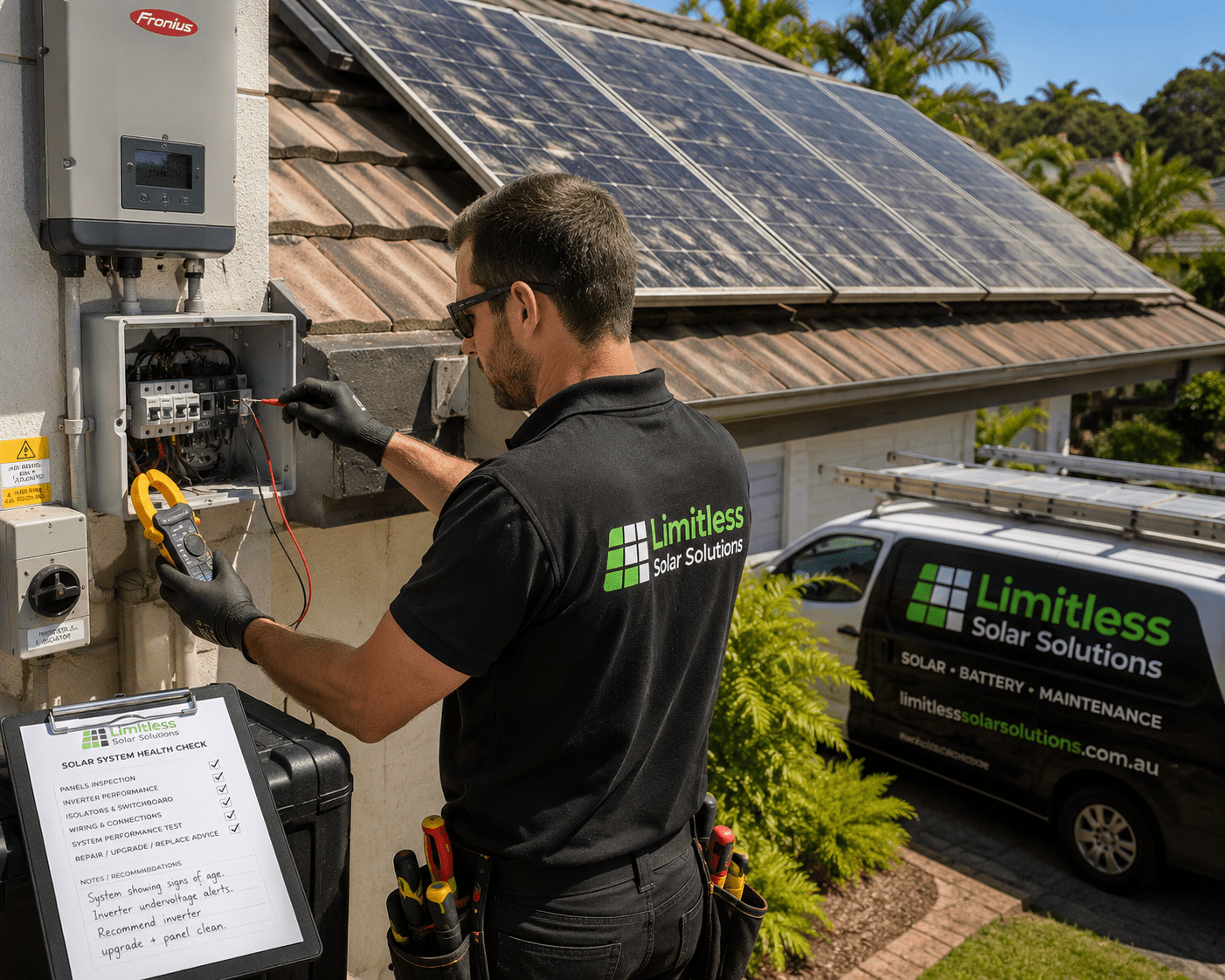
Attempting to diagnose a solar system fault on your own is not only difficult but also extremely dangerous. Solar panels generate high-voltage DC electricity whenever they are exposed to light, even if the system is switched off at the main board. For this reason, a professional health check from a licensed and SAA (Solar Accreditation Australia)-accredited technician is absolutely essential for an accurate and safe diagnosis.
Professionals use specialised diagnostic tools that go far beyond a simple visual inspection. At Limitless Solar Solutions, our technicians use thermal imaging cameras to detect “hot spots” on panels, which are invisible to the naked eye and can indicate damaged cells or pose a fire risk. They also perform insulation resistance tests and string voltage tests to pinpoint electrical faults with precision. This comprehensive evaluation covers every part of your system, from the panels and inverter to the cabling and rooftop isolators. This detailed inspection makes sure we identify the true root cause of the problem, allowing you to make a fully informed decision about the best path forward and mitigating potential safety hazards.
When Does Repairing Your Solar System Make Sense?
Opting to repair your solar system is often the most practical and budget-friendly choice when the issue is isolated and the rest of your system is in good health. If a minor component fails or you have an issue that is still covered under warranty, a targeted repair can restore your system to full functionality without the expense of a major overhaul. This approach is ideal for newer systems where the core components like panels and inverters have many years of operational life left.
Addressing a specific fault promptly not only gets your system back online, but it also prevents smaller issues from developing into larger, more expensive problems. Whether it’s replacing a faulty isolator or fixing damaged wiring, a strategic repair can be a highly effective solution. The key is to make sure the repair is carried out by a qualified professional to maintain system safety and compliance.
What Common Solar Faults Can Be Repaired?
Many common solar system problems are confined to specific components that can be repaired or replaced without needing a complete system overhaul. Understanding these repairable issues helps you see when a simple fix is the right call.
-
Inverter Testing & Repairs: Since the inverter is the hardest-working part of your system, it’s a common failure point. If your panels are in good shape but the inverter has failed, an expert technician can assess whether a repair is possible or if a simple inverter replacement is the most cost-effective solution to restore energy conversion.
-
Faulty DC Isolators: In Queensland’s climate, rooftop DC isolators are notoriously prone to failure from water ingress and UV degradation. This is a serious fire hazard. Replacing a faulty or recalled isolator (from brands like Salzer or ISO MAX) is a standard and necessary repair that a professional can handle safely.
-
Damaged Wiring & Connections: Your system’s wiring can be damaged by UV exposure over time or chewed by local wildlife like possums. A skilled technician can locate and replace compromised sections of cable or faulty MC4 connectors to restore safe and efficient power flow, with a typical solar panel repair cost in Australia being far less than a full replacement.
-
Single Panel Replacement: If a single panel is damaged by a fallen branch or localised hail, it can often be replaced. The main challenge is finding a panel with compatible electrical characteristics to maintain system balance. For minor issues like heavy soiling, professional module cleaning from Limitless Solar Solutions can restore performance.
-
Performance Monitoring: Sometimes the issue is with the monitoring unit itself, rather than the generation components. An expert can diagnose and fix communication problems, making sure your performance tracking app provides accurate data on your system’s energy production.
Does Your Warranty Cover Solar System Repairs?
Before paying for any repairs, it is important to check the status of your existing warranties, as they can significantly reduce your out-of-pocket costs. Solar systems are typically covered by several different warranties that apply to different parts of the installation.
-
Workmanship Warranty: This warranty is provided by your original installer and covers any defects related to the installation process, such as roof leaks or faulty wiring. This coverage usually lasts for five to ten years.
-
Inverter Product Warranty: The inverter itself comes with a manufacturer’s warranty, typically for five to ten years. If it fails within this period, the manufacturer is responsible for providing a replacement unit, though you may still be responsible for the labour cost of the swap.
-
Panel Product Warranty: Solar panels have a product warranty covering physical defects, which can range from 10 to 25 years on modern panels. This is separate from the 25-year performance warranty that guarantees a certain level of output.
-
The “Orphaned System” Challenge: A major issue arises if your original installation company has gone out of business. This is known as an “orphaned system,” and claiming your workmanship warranty becomes impossible. In this situation, a reputable company like Limitless Solar Solutions can often step in to help you navigate manufacturer warranty claims directly.
Why Should You Replace Your Solar System?
There are clear situations where continuing to repair an old, inefficient solar system no longer makes financial sense. A full system replacement can be the best long-term decision when faced with technological obsolescence, severe degradation, or a system that is simply too small for your current energy needs. While the upfront cost is higher, a replacement offers a fresh start with the latest technology, full warranty coverage, and compliance with modern safety standards.
Replacing an old system often delivers a much stronger return on investment than pouring money into constant repairs, a conclusion supported by Renovation of Grid-Tied Solar photovoltaic plants research examining the economic prospects of system-level upgrades. With the benefit of government incentives on new installations, the final cost can be surprisingly competitive. This move makes sure you have a reliable, high-performing asset for decades to come.
“Many homeowners hold onto outdated 1.5kW to 3kW systems that were great a decade ago but are now completely undersized. Replacing that with a modern 6.6kW or 10kW system isn’t just a repair—it’s a fundamental upgrade to your home’s energy infrastructure that delivers exponentially greater savings.” — Clean Energy Council Accredited Installer
When Is a Full Solar System Replacement The Most Economical Choice?
Several financial tipping points make a full replacement a more sensible decision than a costly repair. Recognising these scenarios can save you money and frustration in the long run.
-
“Orphaned Systems” Beyond Warranty: If the inverter fails on a system where the original installer has disappeared and the warranty has expired, you face a significant cost for a new unit and installation. This expense can be a large portion of the cost of a brand-new, fully-warrantied system, making the choice to replace the solar inverter or the whole system an easy one.
-
Technological Obsolescence: Early solar systems were small (1.5kW-3kW) and used panels with lower outputs (190W-250W). These are now undersized for the average household, and finding compatible replacement parts is nearly impossible. Upgrading to a modern system is the only practical solution.
-
The 50% Rule: A good rule of thumb is that if the estimated cost to repair your old system is more than 50% of the cost of a new, equivalent system, replacement is generally the better financial move — a principle consistent with By popular demand: Software estimating rules of thumb and their application in engineering cost decision-making. This helps prevent over-investing in ageing technology, and applying Bayesian Rules of Thumb: to early-stage cost estimation can further sharpen the accuracy of repair-versus-replace financial projections.
-
Escalating Maintenance Costs: If your system requires frequent service calls for different issues, those repair costs add up quickly. A new installation resets the clock with fresh warranties, eliminating the constant drain of maintenance expenses.
-
STC Rebates: The Australian Government’s Small-scale Technology Certificates (STCs) provide a substantial upfront discount on new solar installations. This rebate does not apply to repairs, meaning the net cost of a new system is often much lower than you might think.
Are There Safety and Compliance Benefits to Replacing an Old System?
Replacing an old solar system isn’t just about performance; it’s also a major step forward for safety and electrical compliance. Australian electrical standards, particularly AS/NZS 5033, are regularly updated to improve safety and mitigate risks like fires and electrocution. An older system may not meet these current standards, creating potential hazards.
A significant repair on an old system can legally trigger a requirement to bring the entire setup into compliance with the latest regulations. This could involve expensive work like rewiring, replacing all DC isolators, and upgrading earthing systems. The cost of these mandatory compliance upgrades can sometimes make a full replacement the more economical option. By installing a brand-new system, you make sure every component is modern, compliant, and installed to the highest safety standards. This often includes the opportunity to upgrade your home’s main switchboard with modern circuit breakers and safety switches (RCDs), which protects your entire property.
Upgrading Your Solar System: Improving Performance and Value
Sometimes, the best path isn’t a simple repair or a full replacement, but a strategic upgrade. If your solar system is functional but underperforming or lacking modern capabilities, targeted component upgrades can be a highly effective way to boost its performance and future-proof your investment. This approach allows you to utilize the parts of your system that are still in good condition while improving its overall efficiency and functionality.
Upgrading is an excellent strategy for increasing your energy independence, especially in a market with declining feed-in tariffs. By integrating modern technologies like battery storage and EV charging, you can convert your existing setup into a comprehensive home energy solution. This provides the greatest long-term value and makes sure your system is ready for the energy needs of the future.
What Are Your Best Solar System Upgrade Options?
If you’re looking to boost your system’s performance, several key upgrades can deliver significant results. These options allow you to modernise your setup and get more out of your initial investment.
-
High-Efficiency Panel Upgrades: One of the most impactful solar system upgrade options is replacing old, low-wattage panels with modern models that can exceed 400W each. This can dramatically increase your system’s total generation capacity without needing more roof space.
-
Inverter Replacements: Swapping an ageing string inverter for a newer model can improve efficiency and provide you with sophisticated app-based monitoring features. This gives you better insight into your energy production and consumption.
-
Hybrid Inverter Upgrades: Even if you’re not ready for a battery just yet, upgrading to a hybrid inverter makes your system “battery-ready.” This is a smart, forward-thinking move that saves you from needing more costly hardware additions later on.
-
System Reconfiguration: A solar professional can assess your current panel layout and suggest changes to minimise the impact of shading from trees or new structures. This can involve modernising the string design or relocating a few panels for optimal sun exposure.
-
Performance Monitoring Add-ons: If your old system lacks monitoring, you can install modern, app-based tools. These devices allow you to track your energy generation and savings in real time, empowering you to make smarter energy usage decisions.
Why Should You Consider Battery Storage and EV Charging Integration?
Integrating battery storage and Electric Vehicle (EV) charging is the ultimate way to maximise the value of your solar system. With Queensland’s feed-in tariffs continuing to fall, exporting excess power to the grid offers minimal financial return. The real savings now come from self-consumption.
Adding a solar battery upgrade in Australia, such as a Tesla Powerwall 3 or a system from Enphase or Sungrow, allows you to store the free solar energy you generate during the day. You can then use that stored power during the evening peak, when electricity from the grid is most expensive. This provides energy independence, resilience against outages, and protects you from blackouts. The adoption of EVs is also rising fast, with a 65% increase in sales in 2023. Installing a smart EV charger like a Zappi or Wallbox lets you fuel your car with sunshine, drastically reducing both your electricity and transport costs. Limitless Solar Solutions designs all upgrades to be compatible with these future-focused technologies.
Commercial Solar Systems: Strategic Repair, Upgrade, Or Replacement For Businesses
For small to medium-sized businesses on the Sunshine Coast and North Brisbane, a solar system is a critical asset for managing operational costs. The decision to repair, upgrade, or replace a commercial solar system is therefore driven by return on investment (ROI), operational continuity, and the ability to scale. Downtime is not just an inconvenience; it represents a direct financial loss.
Because businesses typically consume most of their energy during daylight hours, maximising solar self-consumption is paramount. Decisions about solar infrastructure must be strategic, taking into account not only the immediate fault but also the company’s future growth and energy needs. Financial incentives like tax write-offs also play a much larger role for commercial operators.
How Do Commercial Needs Influence Solar System Decisions?
The factors influencing solar system decisions for a business are distinct from those of a homeowner. Operational demands and financial planning take centre stage, shaping the choice between a quick fix and a long-term strategic investment.
-
Cost of Downtime: When a commercial solar system goes offline, the business is immediately forced to buy expensive peak-rate electricity from the grid. For a manufacturing plant or cold-storage facility, this can cost thousands of dollars, making a rapid replacement often more logical than a lengthy repair process.
-
Scalability for Growth: A business that has expanded its operations may find its original solar system is now undersized. Upgrading or replacing the array allows the business to match its energy generation to its current and future consumption needs.
-
Operational Demands: Many businesses rely on a continuous power supply for critical equipment. A modern system with battery backup can provide invaluable protection against grid outages, preventing data loss or stock spoilage.
-
Limitless Solar Solutions’ Commercial Services: We provide tailored commercial solar upgrades, system expansions, and ongoing service plans designed specifically for the needs of local businesses in the Sunshine Coast and North Brisbane regions.
Are There Financial Benefits for Commercial Solar Replacements?
For businesses, replacing an ageing commercial solar system comes with significant financial advantages that go beyond simple energy savings. These incentives can make a full replacement a highly attractive investment.
“For a commercial enterprise, a new solar system isn’t just an expense; it’s a depreciable asset. The ability to take advantage of the Instant Asset Write-Off or other depreciation schedules can drastically improve the payback period and overall ROI, making replacement a powerful financial tool.” — Commercial Finance Advisor
-
Tax Benefits: Under current Australian tax law, businesses may be able to take advantage of the instant asset write-off or favourable depreciation schedules for new solar infrastructure. This can substantially reduce the net capital cost of the investment and accelerate tax deductions.
-
Improved ROI: A new, larger, and more efficient system provides greater energy savings, leading to a faster payback period compared to the ongoing costs of maintaining an obsolete system.
-
Reduced Operating Costs: A modern solar array designed to meet a business’s full energy load can dramatically slash overheads by minimising reliance on expensive grid electricity.
-
Queensland Incentives: Our team at Limitless Solar Solutions helps businesses navigate any available state-level grants or rebate schemes targeted at improving energy efficiency for SMEs.
Navigating Warranties, Standards, and Government Incentives
Making an informed decision about your solar system requires a clear understanding of the warranties, safety standards, and financial incentives available in Australia. These factors can heavily influence the cost-effectiveness of repairing, upgrading, or replacing your system. Knowing your rights under warranty and the support available from government schemes is important for making the best financial choice.
Federal STCs and Queensland-specific incentives can make a huge difference to the upfront cost of a new or upgraded system. At the same time, adhering to Australian safety standards is non-negotiable to protect your property and make sure your system operates reliably for years to come.
Understanding Solar System Warranties and Compliance
Navigating the different types of warranties and understanding your compliance obligations is a key part of managing your solar asset. A professional can help you make sense of these important protections and requirements.
-
Performance vs. Product Warranties: It’s important to know the difference. A product warranty covers physical defects in a panel or inverter, while a performance warranty guarantees a certain level of energy output over 25 years. The product warranty is often the more practical and valuable of the two, covering hardware failures.
-
Retailer Workmanship Warranties: Your installer provides a workmanship warranty covering the quality of the installation itself. Choosing an established, local provider like Limitless Solar Solutions makes sure you have access to this support for the long term.
-
Australian Standards (AS/NZS 5033): All solar installations and significant modifications must comply with current Australian safety standards. This is a legal requirement designed to prevent electrical and fire hazards, and ensuring compliance is vital for safety.
-
SAA Accreditation: Always use a technician who is fully licensed and SAA-accredited (Solar Accreditation Australia). This guarantees their work meets the highest industry standards for safety and quality, which is a core promise of every technician at Limitless Solar Solutions.
What Government Incentives Are Available For Solar Upgrades?
Government incentives are designed to make renewable energy more affordable and can significantly impact your decision to upgrade or replace your system. These programs can reduce the upfront cost by thousands of dollars.
-
Small-scale Technology Certificates (STCs): This federal scheme provides a point-of-sale discount on new solar systems and significant capacity upgrades. The value of this rebate is substantial, but it does not apply to simple repairs — understanding how numerical incentive values are presented and perceived can also influence uptake, as explored in research on “Less is… more?” The influence of digit magnitude and formatting on probability weighting in consumer financial decisions. The final solar panel replacement cost in Australia is greatly reduced by this incentive.
-
STC Phase-Out: It is important to know that the STC scheme is being phased out, with the value of the rebate decreasing on the 1st of January each year until it ends in 2030. Acting sooner secures a larger discount.
-
Queensland Incentives: The Queensland Government offers programs to support homeowners, including interest-free loans of up to $10,000 for the installation of battery storage systems.
-
Optimising Feed-in Tariffs (FiTs): While not a direct incentive, modern systems with advanced monitoring help you maximise your self-consumption. This strategy provides far greater savings than exporting power for low feed-in tariffs.
Making The Best Choice For Your Property With Limitless Solar Solutions
The decision to repair, upgrade, or replace your solar system is specific to your property, energy needs, and financial situation. The best choice comes from a thorough, professional assessment by a trusted local expert.
For homeowners and businesses on the Sunshine Coast and in North Brisbane, Limitless Solar Solutions offers transparent advice and expert service. Our SAA-accredited team will conduct a detailed health check to give you a clear, data-driven recommendation. Contact us today for a personalised consultation and take the first step toward a reliable and efficient energy future.
Frequently Asked Questions
Question: How often should a solar system be serviced in Queensland?
A residential solar system should be inspected every 12 to 24 months, or annually if your property is in a coastal or heavily treed area. Commercial systems often benefit from more frequent scheduled maintenance to make sure optimal performance and ROI.
Question: What are the primary signs of a faulty solar inverter?
The main signs include flashing red or orange lights, a completely blank display screen during the day, or specific fault codes like “Isolation Fault.” You might also notice a sudden and significant drop in power production tracked through your monitoring app.
Question: Are there government rebates available for solar system upgrades in Queensland?
Yes, the federal STC rebate applies to new installations and significant upgrades, providing an upfront discount. The Queensland Government also offers support, including interest-free loans of up to $10,000 for eligible homeowners installing a new battery storage system.
Question: Can I add a battery to my old solar system?
Yes, this is usually possible. You can either use an AC-coupled solution, which involves adding a separate battery inverter, or upgrade your existing inverter to a modern hybrid model. Limitless Solar Solutions can assess your system and recommend the best integration method.
Question: What is the typical lifespan of solar panels and inverters in the Australian climate?
High-quality solar panels are designed to last 25 to 30 years, with their efficiency slowly degrading by about 0.5% to 0.8% annually. String inverters experience more stress and typically require replacement every 10 to 15 years.
Question: What does an “orphaned solar system” mean, and what should I do if I have one?
An orphaned system is one where the original installation company has gone out of business, leaving you without workmanship warranty support. You should contact a reputable local provider like Limitless Solar Solutions to assess the system and assist with any manufacturer warranty claims.
Question: How does the coastal environment affect solar panel longevity and performance?
The coastal environment, with its salt spray and high humidity, can accelerate the corrosion and degradation of solar system components, including frames, racking, and electrical connections. Limitless Solar Solutions uses marine-grade components and conducts corrosivity assessments to make sure longevity for coastal properties.