

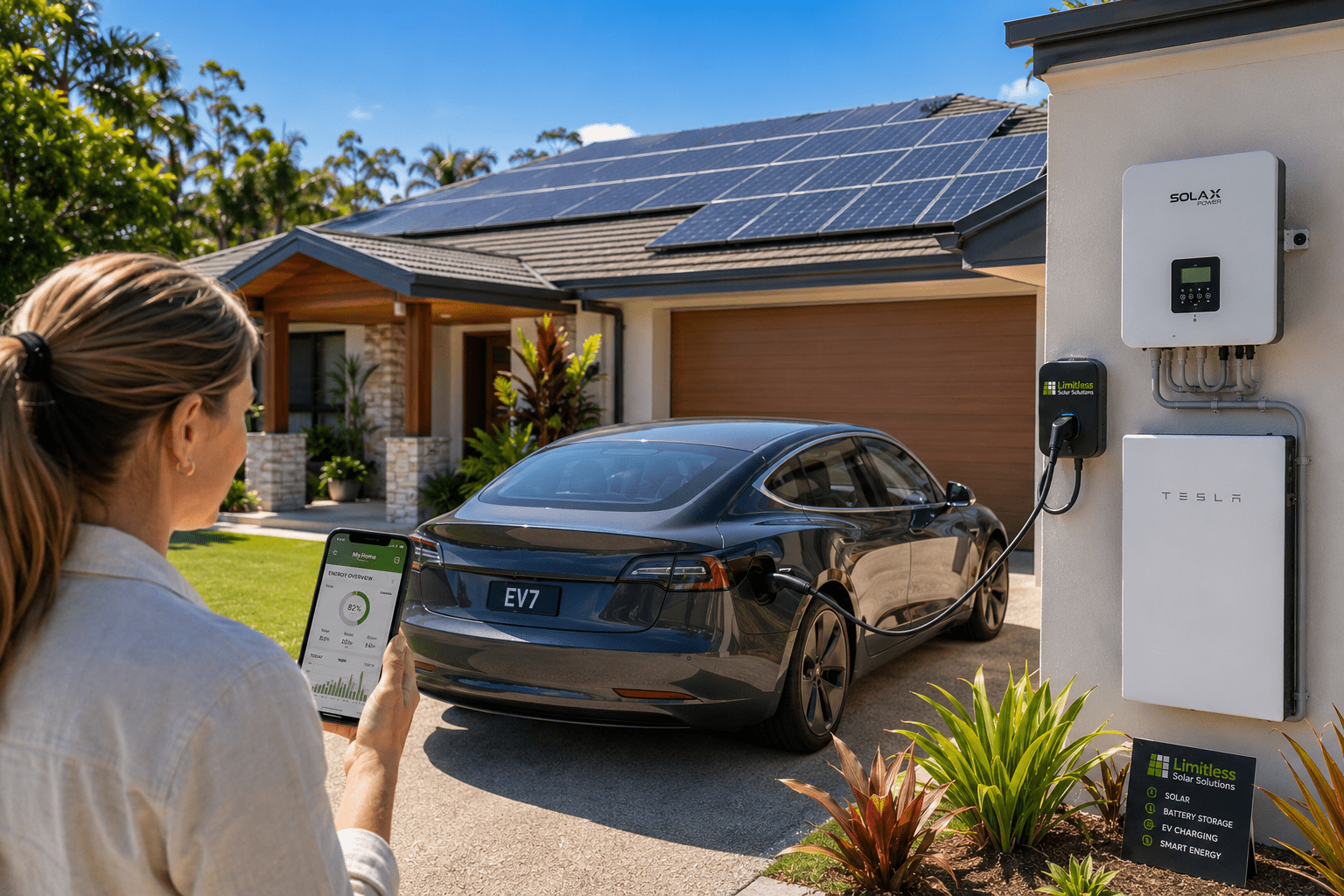
Wondering if you can charge EV with solar power at home instead of relying on expensive grid electricity? For many Queensland homeowners, the answer is yes. With the right solar panel system, smart EV charger and optional battery storage, you can use clean rooftop solar energy to power your electric vehicle, reduce running costs and move closer to genuine energy independence.
Key Takeaways
-
Powering your car with sunshine is entirely possible for Queensland homeowners. The key is a correctly sized solar system combined with a smart EV charger that directs surplus energy straight into your vehicle’s battery.
-
For those needing to charge their electric vehicle overnight, a home battery storage system offers the ideal method. It stores excess solar energy generated during the day, providing the flexibility to charge whenever suits your schedule.
-
Proper system sizing and planning are fundamental to getting a good return on your investment. A professional consultation will help ensure your system meets both your household’s and your EV’s energy demands efficiently.
-
Working with an SAA-accredited installer is non-negotiable. It helps guarantee your system is safe, complies with all local Queensland regulations, and maximises your potential savings for years to come.
Jump to section
- Can You Charge an EV with Solar at Home? Understanding the Basics
- Sizing Your Solar System: How Much Solar Do You Need for Your EV?
- Choosing the Right Charger: Smart Solar EV Chargers vs. Standard Units
- Beyond Daylight: Can You Charge Your EV at Night with Solar?
- Preparing for Installation: Essential Checks for Your Home and System
- Maximising Your Investment: Financial Benefits and Long-Term Value
- Drive on Sunshine: Your Path to Energy Independence
- Frequently Asked Questions
Can You Charge an EV with Solar at Home? Understanding the Basics
Yes, you can absolutely charge an EV with solar power at home, and it’s a highly effective way for Queenslanders to make a genuine zero-emissions driving contribution and significantly reduce running costs. Understanding the basics involves two main components: your solar panels and a smart EV charger. Your solar panels generate direct current (DC) electricity, which a solar inverter converts into alternating current (AC) electricity to power your home.
A smart solar EV charging station for home use serves as the vital connection that makes this process efficient. Rather than allowing your excess solar energy to flow back to the grid for a minimal feed-in tariff, a smart charger intelligently detects this surplus power. It then automatically redirects that free, clean energy directly into your electric vehicle, helping ensure no solar generation is wasted.
How Does Solar Power Your Electric Vehicle?
The process to charge an EV with solar panels is straightforward, relying on several key steps to work together seamlessly. First, the photovoltaic (PV) cells in your solar panels capture sunlight and convert it into DC electricity—the raw power from the sun.
Next, this DC power flows to your solar inverter. The inverter acts as the system’s central processor, converting the DC electricity into the 240-volt AC electricity that your home’s appliances and power points use. Your EV charger also uses this AC power. When you plug in your car, its onboard charger performs one final conversion, turning the AC power back into DC to be stored in the vehicle’s battery. A well-designed system, such as those from Limitless Solar Solutions, intelligently prioritises solar energy use: first for your home, then for your EV, before sending any surplus to the grid.
Why Is Solar EV Charging So Efficient and Eco-Friendly?
Using a solar panel EV charger is both highly efficient and environmentally friendly because it establishes a closed-loop energy system for your transport. When you power your car using electricity drawn from the Queensland grid, that power is often sourced from fossil fuels. This effectively shifts your EV’s emissions from the tailpipe to a power station smokestack.
By generating your own power, you contribute to genuinely zero-emissions transport, significantly cutting your household’s carbon footprint — consistent with global progress toward renewable electricity targets tracked by IEEE researchers. This is particularly impactful for environmentally conscious homeowners across the Sunshine Coast and in North Brisbane. Maximising self-consumption means you use the power you generate on-site, granting you greater energy independence. This embodies the true meaning of “driving on sunshine,” allowing you to take charge of your energy future and personal autonomy.
“Powering your EV with solar isn’t just about saving money; it’s about making a tangible difference. Every kilometer driven on sunshine is a step towards a cleaner, more sustainable future for everyone.” – Limitless Solar Solutions
Sizing Your Solar System: How Much Solar Do You Need for Your EV?
Properly sizing your solar panels for EV charging is a critical step. Your system must be large enough to comfortably cover both your existing household energy consumption and the new demands of your electric vehicle. A common guideline suggests that the average EV needs an additional 2.5kW to 3kW of solar capacity for every 10,000 kilometres driven annually.
However, this is only a starting point. A custom system design is the best approach to perfectly balance your home’s unique energy profile with your driving habits. Several factors influence this:
-
Your daily commute distance
-
Whether you typically work from home (impacting daytime charging availability)
-
The specific efficiency of your EV model
-
Your preferred charging speed and habits
This tailored approach helps ensure your investment is optimised for the fastest possible return.
How Do You Calculate Your EV’s Energy Consumption?
To determine your EV’s energy needs, you need to consider two key figures: your daily driving distance and your car’s efficiency rating. The average Australian drives approximately 35 to 40 kilometres per day. Most modern electric vehicles have an efficiency rating of about 15 to 20 kilowatt-hours (kWh) per 100 kilometres travelled.
Let’s illustrate with an example:
-
If you drive 40 km per day and your car uses 18 kWh per 100 km, your daily energy need is (40 km / 100 km) * 18 kWh = 7.2 kWh.
-
For a longer 100 km round trip, you would need (100 km / 100 km) * 18 kWh = 18 kWh.
Understanding your personal driving habits is the essential first step in designing a solar electric car charger system that is precisely tailored to your lifestyle and prevents you from running short on power.
What Solar System Size Is Right for Both Your Home and EV?
To determine the optimal size for your EV charger solar panels, you must combine your household’s current energy use with your calculated EV charging needs. Begin by examining your recent electricity bills to find your average daily household consumption in kWh. Then, add the daily kWh required for your car.
For many Queensland homes adding an EV, a standard 6.6kW solar system may no longer be adequate. Limitless Solar Solutions frequently recommends system sizes ranging from 8kW to 13.2kW for homes aiming to comfortably cover both their base electricity loads and EV charging. This larger capacity offers a crucial buffer for overcast days and helps to future-proof your home. If you anticipate adding a second EV or a home battery in the future, what every homeowner should know about solar upgrades and inconvenience later.
Choosing the Right Charger: Smart Solar EV Chargers vs. Standard Units
Selecting the right hardware is equally as important as the solar panels themselves when you want to charge an EV with solar. A primary decision you’ll face is between a standard charger and a smart solar EV charger. Smart chargers are specifically designed to dynamically adjust their charging rate to match the amount of surplus solar your system is generating, actively preventing the unnecessary drawing of expensive power from the grid — a design principle explored in depth in this solar powered electric vehicle charging system review.
In contrast, a standard or “dumb” charger will pull power at its maximum rate, regardless of the electricity’s source. This can readily result in surprisingly high power bills, even with a substantial solar array on your roof. To genuinely maximise your savings, a smart charger is not merely an optional feature; it is fundamental. Limitless Solar Solutions installs leading brands such as Tesla, Wallbox, Zappi, and Hypervolt, all of which provide dedicated “Eco” or “Solar Only” modes.
Why Are Smart EV Chargers Essential for Solar Homes?
A smart solar powered EV charger is essential because it grants you precise control over your home’s energy flow. These units employ a device called a Current Transformer (CT) clamp, installed within your switchboard to monitor your home’s electricity usage in real-time. When the CT meter detects that your solar system is generating surplus power beyond what your home needs and is about to export it to the grid, it instructs the charger to divert that power to your car instead.
This dynamic process maximises the free, self-generated energy directed to your vehicle. For instance, if a cloud passes overhead and your solar production temporarily drops, the smart charger instantly reduces the charging speed or pauses altogether to prevent drawing power from the grid. This intelligent load management helps ensure you are not accidentally paying for grid electricity when you intend to use free solar power.
What Smart Charger Features Should You Look For?
When choosing a home solar EV charging unit, look for features that offer both flexibility and control. Here are some key features to consider:
-
Dedicated “Eco” or “Solar Only” Mode: This is the most important feature. It allows the charger to intelligently prioritise and use only 100% solar power whenever available. This function is a cornerstone for maximising your self-consumption and helping ensure you’re charging your EV for free.
-
User-Friendly Smartphone App: A robust app allows you to remotely schedule charging sessions, monitor real-time energy usage, track historical data, and easily switch between different charging modes (e.g., pure solar, mixed, or fast grid charging).
-
Tethered vs. Untethered Options: Consider your preference. A tethered charger has a permanently attached cable, offering convenience by always being ready to plug in. An untethered unit requires you to use the charging cable that came with your car, which can be useful if you have multiple EVs with different plug types.
-
Compatibility: Help ensure the charger is compatible with your specific EV model and adheres to local electrical standards.
-
Power Output: While smart chargers adjust, knowing the maximum charging rate (e.g., 7.4 kW for single-phase, 22 kW for three-phase) is important for future-proofing.
Leading brands supplied by Limitless Solar Solutions, including Tesla, Wallbox, Zappi, and Hypervolt, offer these advanced features.
Beyond Daylight: Can You Charge Your EV at Night with Solar?
One of the most common questions for homeowners is how to manage charging an EV at night when the sun isn’t shining. The answer lies in home battery storage. Systems like the Tesla Powerwall 3, Sungrow, or LG Energy Solutions allow you to store the excess solar energy your panels generate during the day for use after sunset, a setup validated by a real-world case study of solar PV integration for EV charging and residential energy demand.
This technology significantly changes the landscape for solar and EV charging, effectively separating your charging time from daylight hours. It means you can arrive home from work, plug in your car, and charge it overnight using the clean energy you captured earlier. A correctly designed system helps guarantee the home battery intelligently prioritises your essential household loads before directing power to your vehicle.
“A home battery system is like having your own personal energy bank. It lets you capture the abundant sunshine during the day and spend it on your EV, or anything else, long after the sun goes down.” – An Energy Expert
How Does Battery Storage Enable Nighttime EV Charging?
A home battery makes solar battery EV charging possible by serving as an on-site energy reservoir. During the day, once your home’s immediate energy needs are met, your solar inverter directs any surplus solar power to charge the battery. This energy is stored, typically in advanced lithium-iron phosphate (LiFePO4) cells, ready for use whenever you need it — a system architecture also examined in IEEE research on the hybrid solar PV system for electric vehicle battery charging.
When the sun sets, your home automatically begins drawing power from the battery instead of the grid. If you plug in your EV, the system’s hybrid inverter will intelligently manage the energy flow, dispatching stored solar power to your car. This allows you to replenish your EV’s battery overnight without paying peak grid electricity rates, moving you closer to complete energy independence.
Prioritising Power: Managing Your Home Battery and EV Charging
When you have both a home battery and an EV battery, it’s vital to manage the power flow intelligently. A typical home battery stores between 10 and 13.5kWh of energy, while an EV battery can hold anywhere from 50 to 100kWh. If not managed properly, your EV could potentially drain your entire home battery, leaving insufficient power for your morning household needs.
A well-designed system offers the capability to set charging priorities. You can configure the system to first use the home battery for your evening household loads, such as cooking and lighting. Then, you can either allow the EV to consume the remaining stored power or schedule its charging during off-peak grid times for a lower rate. This balanced approach helps guarantee you always have power where you need it most.
Practical Tip: Many smart chargers and battery management systems allow you to set minimum charge levels for your home battery. This way, you can help ensure there’s always enough stored power for essential appliances even if your EV is plugged in.
Preparing for Installation: Essential Checks for Your Home and System
Before you can fully enjoy the benefits of a home solar car charger, several essential pre-installation checks are necessary to help ensure a safe and efficient setup. A thorough solar installation process by a qualified professional is the crucial first step. This assessment will review your home’s switchboard capacity, the condition of your existing wiring, and local electrical regulations. This is also the time to ask key questions about the installation process.
It is absolutely vital that any installation work is performed by SAA-accredited, licensed electricians. This is not merely a recommendation; it’s a firm requirement for compliance and safety in Queensland. Choosing a reputable installer helps guarantee your system meets all industry standards, operates correctly, and is eligible for any relevant government rebates.
What Needs to Be Assessed Before Installing an EV Charger?
Before installing an EV charger at your property, several key elements need careful assessment. Here’s what to ask and check:
-
Switchboard Capacity: Your home’s main switchboard must be capable of handling the high, continuous load of an EV charger. A licensed electrician will evaluate if there is sufficient physical space and electrical capacity for a new dedicated circuit. In older homes or those with existing high-demand appliances, a switchboard upgrade may be necessary.
-
Wiring and Electrical Infrastructure: The assessment involves thoroughly checking the condition and size of the wiring from your switchboard to the proposed charger location. Older homes, in particular, may require new, thicker cabling to safely support the power draw of a modern Level 2 charger, preventing overheating or electrical issues.
-
Single-Phase vs. Three-Phase Power: Most Australian homes are supplied with single-phase power, which typically supports EV charging up to 7.4kW. Commercial properties or larger residential homes with three-phase power can support significantly faster charging speeds, often up to 22kW. This crucial detail will be determined during the site inspection and affects your charging options.
-
Proposed Charger Location: Consider proximity to your parking spot, accessibility, and weather protection. The installer will help identify the best spot for efficiency and convenience.
-
Professional Site Inspection: A professional assessment from a licensed electrician is fundamental. They will identify any potential issues, confirm feasibility, and help guarantee the installation plan is safe, compliant, and precisely tailored to your home’s specific layout and existing electrical system.
Ensuring Compliance and Safe Installation in Queensland
Helping ensure your installation is compliant with local regulations safeguards both your home and your investment. In Queensland, specific rules govern the installation of high-load appliances like EV chargers.
-
SAA Accreditation: Always choose an installer with Solar Accreditation Australia (SAA) accreditation. This certification is a mark of quality and indicates the installer is trained to the highest industry standards. Limitless Solar Solutions uses only in-house SAA-accredited electricians for all installations.
-
Local Expertise: An installer with local expertise has a deep understanding of the specific requirements set by Energex, the network provider for regions like the Sunshine Coast and North Brisbane. This knowledge is important for a smooth grid-connection process and helps confirm compliance with all regional building codes and permits.
-
Queensland Electrical Regulations: Adherence to state-specific electrical standards is mandatory. This includes rules around active device management for chargers that draw a high load, which helps maintain grid stability. A qualified installer will expertly manage all these technical and regulatory requirements.
-
Transparency: A reputable installer will provide a clear, detailed, and comprehensive quote after a thorough site assessment. This quote should clearly outline all costs, including the charger unit, labour, and any necessary switchboard or wiring upgrades, so you encounter no unexpected surprises.
“When it comes to electrical work, especially with high-power systems like EV chargers, safety and compliance are paramount. Always choose a licensed and accredited professional.” – Queensland Electrical Safety Office Guidelines
Maximising Your Investment: Financial Benefits and Long-Term Value
Investing in a system to charge an EV with solar provides significant financial benefits that extend well beyond just saving on petrol. By powering your car with self-generated electricity, you notably reduce both your fuel costs and household electricity bills, leading to a rapid return on investment (ROI) for your system.
Furthermore, an integrated solar and EV charging system significantly increases the value and appeal of your property. As more Queenslanders transition to electric vehicles, homes already featuring this future-ready technology will be in high demand. It represents a smart investment in both your financial well-being and your home’s long-term marketability.
How Does Solar EV Charging Save You Money?
The financial savings from a solar car charging station stem from several key areas. Primarily, you are replacing expensive petrol or diesel with lower-cost electricity. More importantly, you are using your own generated solar power rather than paying for grid electricity. In Queensland, standard grid power can cost anywhere from $0.25 to $0.35 per kWh.
In stark contrast, the “cost” of using your own solar is the Feed-in Tariff (FiT) you forgo by not exporting that energy to the grid, which is often only $0.04 to $0.08 per kWh. This means you are effectively fuelling your car for a fraction of the price.
-
Example: If you drive 40 km daily, needing 7.2 kWh of charge:
-
Grid charging at $0.30/kWh = $2.16 per day
-
Solar charging (forgoing FiT) at $0.06/kWh = $0.43 per day
-
Daily saving = $1.73 (over $600 annually for just 40km of daily driving)
-
For many homeowners, the combined savings on fuel and electricity can lead to a rapid solar payback periods for the entire system, often in as little as 3 to 5 years.
What Government Incentives and Property Value Benefits Are Available?
The Australian government provides incentives that help reduce that help reduce the upfront cost of installing solar. The Small-scale Renewable Energy Scheme (SRES) issues Small-scale Technology Certificates (STCs), which effectively act as a point-of-sale discount on your new solar system. An experienced installer, like Limitless Solar Solutions, can help you navigate this process to maximise your savings by applying the STC value directly.
Beyond these initial rebates, a home featuring an integrated EV solar charging system is a highly attractive and valuable asset. It signals to potential buyers that the home is modern, energy-efficient, and prepared for the future of transport. Additionally, you can take advantage of special Time-of-Use (ToU) electricity tariffs or “Solar Sponge” tariffs offered by some electricity retailers. These tariffs provide cheaper grid power during specific periods, often during the day when solar production is high but demand might be lower, allowing you to further reduce costs if you need to top up your EV from the grid.
Drive on Sunshine: Your Path to Energy Independence
Making the decision to charge an EV with solar represents a powerful step towards a cleaner, more affordable future. It significantly reduces your environmental impact, provides substantial savings on fuel and electricity, and moves you closer to genuine energy independence. By harnessing the abundant sunshine across the Sunshine Coast and in North Brisbane, you gain the power to fuel both your home and your vehicle.
The key to success is a professionally designed and installed system, meticulously tailored to your specific energy needs and driving habits. With the right equipment and local expertise, you can confidently make the transition to solar-powered EV charging.
If you’re ready to explore how you can “drive on sunshine,” contact the team at Limitless Solar Solutions today for a personalised consultation.
Frequently Asked Questions
Question: How Many Solar Panels Are Needed to Charge an Electric Car?
Answer: The number of solar panels required depends largely on your daily driving distance and current household energy consumption. As a general guide, plan for an additional 2.5kW to 3kW of solar capacity for every 10,000 kilometres you drive annually. This extra capacity is added on top of the solar needed to cover your regular household electricity use. A professional assessment will determine the precise number.
Question: What Is the Typical Cost of a Home Solar EV Charging Station Installation?
Answer: The total cost for a home solar EV charging station installation can vary significantly. The charger unit itself typically ranges from $700 to over $2,500, depending on the brand, features, and power output. Installation labour generally costs between $800 and $1,500+, but this can change based on the complexity of the job, the distance from your switchboard, and any necessary electrical upgrades like a switchboard capacity upgrade.
Question: Can I Use My Existing Solar System to Charge My EV?
Answer: Yes, you can potentially use your existing solar system to charge your EV, but its effectiveness depends heavily on your system’s size and your household’s energy consumption patterns. Many older solar systems were sized solely for household use and may not generate enough surplus capacity to effectively charge an EV. A professional consultation with an installer like Limitless Solar Solutions can accurately determine if your existing system is adequate or if an upgrade or expansion is recommended.
Question: How Long Does It Take to Charge an EV Using Home Solar?
Answer: The charging speed when using home solar depends on several factors: your solar system’s output, the type of EV charger you have (e.g., Level 1, Level 2), and your car’s battery size. A Level 2 smart charger will dynamically optimise the speed based on the available sunlight. On a bright, sunny day, you could typically add around 40 kilometres of range per hour, meaning a full charge could take several hours depending on your battery’s capacity and how depleted it is.
Question: What Happens if It’s Cloudy or Rainy? Can I Still Charge My EV with Solar?
Answer: Yes, solar panels still produce some power on cloudy or rainy days, though significantly less than in direct sunlight. Your smart charger will automatically adjust and slow down the charging rate to match the reduced available solar power. If you have a home battery, you can utilise its stored energy for charging. Otherwise, your charger can be configured to seamlessly draw power from the grid when solar generation is insufficient, helping ensure you’re never left without charge.