

Thinking about a solar battery system to keep the lights on during a blackout? It’s a common reason Queensland homeowners invest in solar storage, especially with our wild storm seasons. But many people are surprised to learn that not all solar setups provide power during a grid outage.
True solar battery backup power needs a specific design that allows your home to safely disconnect from the grid and run on its own stored energy.
This system creates a personal microgrid for your property — a concept explored in depth by research on enhancing microgrid resilience through integrated inverter strategies — making sure that when the power goes out for the street, your essential appliances can keep running. We will explore what this really means, from the hardware required to the design decisions you’ll need to make. It is important to approach this investment with clear and realistic expectations about what a battery system can and cannot do during an outage.
Let’s look at how you can gain genuine energy security for your home.
“The key to true energy independence during an outage isn’t just having solar panels; it’s having a system designed to keep your home safely powered when the grid goes dark.”
Key Takeaways
-
True backup power is not an automatic feature of standard solar panel systems. During a grid failure, most solar systems are designed to shut down completely for safety, even if the sun is shining brightly. This is a mandatory safety feature.
-
Gaining blackout protection requires a specific configuration that includes a solar battery with an uninterruptible power supply (UPS) or emergency power supply (EPS) function. This allows your home to safely island itself from the main electricity grid.
-
The design of your system dictates which appliances and circuits will receive power during an outage. You can choose between backing up a few essential circuits or attempting a more complex and costly whole-home backup system.
-
Reliable backup power depends heavily on the type of battery technology used, the accurate sizing of the system to meet your specific needs, and most importantly, expert installation by accredited professionals who understand local regulations.
-
Limitless Solar Solutions specialises in designing and installing these custom-built backup systems. We help Queensland homeowners create setups that provide genuine peace of mind and energy independence when it matters most.
Jump to section
- What Is Solar Battery Backup Power, Really?
- How Do You Design a Solar Battery System for Real Backup Power?
- Is Simply Having a Battery Enough for Backup Power? Addressing Common Misconceptions
- What Factors Affect Your Solar Battery Backup Performance?
- Choosing the Right Partner for Reliable Backup Power in Queensland
- Prepare Your Queensland Home for Uninterrupted Power with Limitless Solar Solutions
- Frequently Asked Questions
What Is Solar Battery Backup Power, Really?
Solar battery backup power is a function that allows a home or business to use stored energy from a battery when the main electricity grid fails. This is fundamentally different from a standard grid-tied solar system, which cannot provide power during a blackout. A system with true backup capability is specifically engineered to safely disconnect from the grid and use its battery and solar panels to create a self-sustaining microgrid for your property. This makes sure your essential appliances remain operational.
Many homeowners believe that having solar panels means they will have power when the sun is shining, regardless of the grid’s status. However, this is a common misconception. For safety reasons, standard solar systems are required to shut down during an outage, a requirement grounded in well-documented 1562-2007 – IEEE Guide standards for stand-alone PV systems. To get genuine backup power, you need a battery storage system designed with what is often called “blackout protection” or an Uninterruptible Power Supply (UPS) function, allowing it to operate independently. This means your home effectively becomes its own small, independent power grid when the main grid fails.
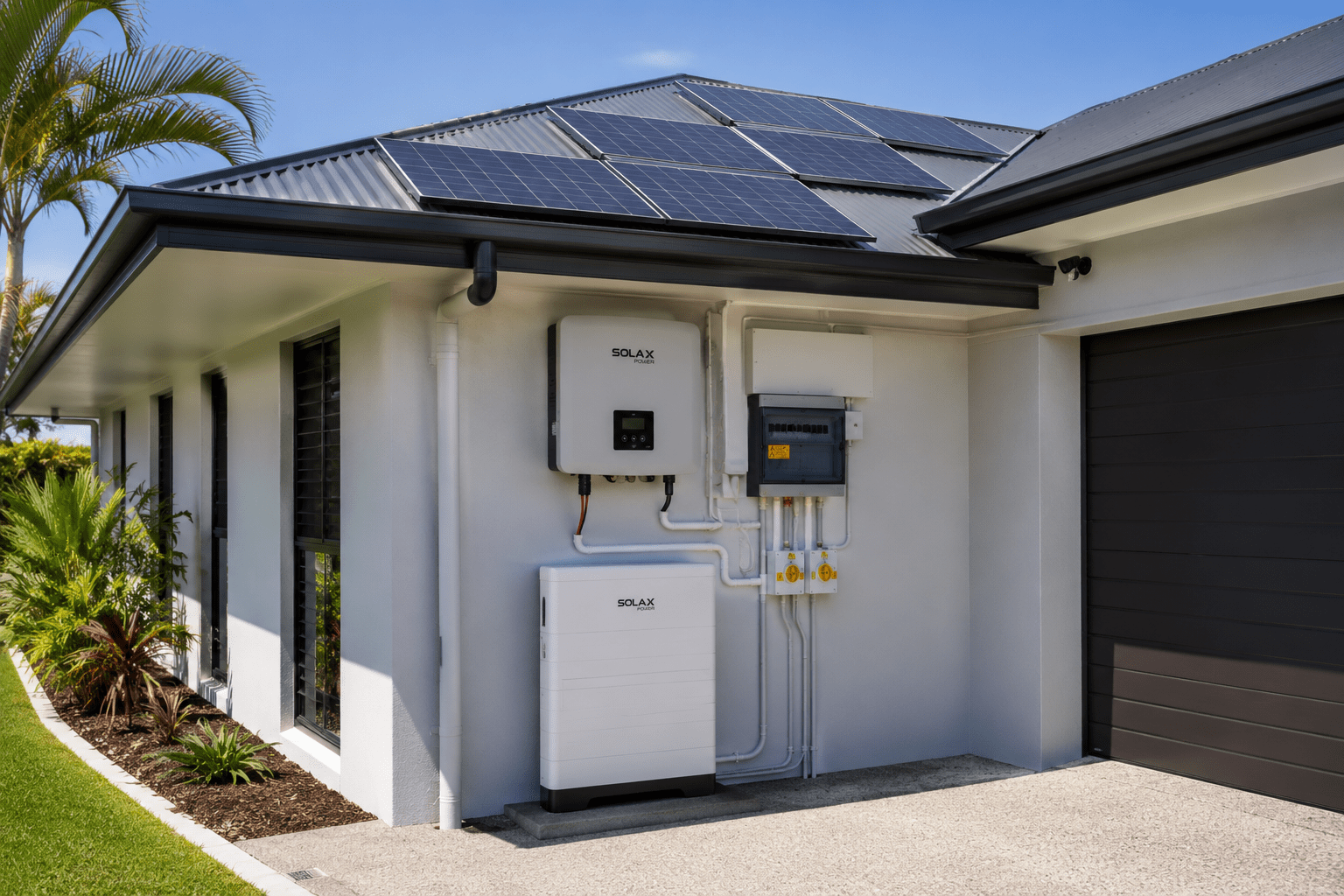
Why Do Standard Solar Systems Shut Down During a Blackout? The “Anti-Islanding” Rule
A standard solar system shuts down during a blackout because of a mandatory safety feature known as “anti-islanding.” This regulation is in place to protect utility workers who are repairing the power lines. An “island” refers to a section of the grid that remains powered by a local generator, like a solar system, even when the rest of the network is de-energised. This creates a highly dangerous environment for line workers.
To prevent this, every grid-tied solar inverter in Australia is designed to constantly monitor the grid’s voltage and frequency. The moment it detects an outage, it must shut down within milliseconds. This immediate disconnection makes sure that no electricity from your solar panels can back-feed into the grid, eliminating the risk of electrocuting technicians working on what they believe are dead power lines. While essential for safety, it means without a special backup configuration, your solar panels are useless during an outage.
What Is Blackout Protection (UPS Capability) and How Does It Work?
Blackout protection, or UPS capability, is the technology that enables a solar battery system to provide power during a grid failure. It works by using an automatic transfer switch (ATS) or an internal contactor within a hybrid inverter. When this device detects a loss of power from the grid, it physically and instantly disconnects your property’s electrical circuits from the external network.
Once your home is safely isolated, the system creates its own stable, self-contained “microgrid.” The solar inverter and battery then begin supplying power directly to your home’s circuits. This switchover process is incredibly fast, often taking just a few milliseconds. In many cases, the transition is so seamless that you might not even notice the grid has gone down until you look outside. For sensitive electronics like computers and routers, this near-instantaneous switch means virtually no interruption, preserving your work and connectivity. Limitless Solar Solutions has extensive experience in configuring this essential feature, making sure your home has a reliable power source when you need it most.
How Do You Design a Solar Battery System for Real Backup Power?
Designing a solar battery system for effective backup power involves a detailed and personalised approach, as there is no one-size-fits-all setup. It begins with understanding exactly what you need to power during an outage and for how long. The process requires careful consideration of which appliances are essential versus which ones are conveniences, as this decision directly impacts system cost, complexity, and performance.
Beyond just selecting loads, accurate system sizing is a vital step. This involves a technical analysis of not only the battery’s storage capacity, measured in kilowatt-hours (kWh), but also its continuous power output, measured in kilowatts (kW). A properly designed system balances these factors to make sure it can both store enough energy and deliver it at a rate sufficient to run your chosen appliances without overloading. This initial consultation is where expectations are clearly set, ensuring the final system aligns with your needs and budget.
Essential Loads vs. Whole-Home Backup: What Do You Really Need to Power?
A key decision is choosing between backing up only essential loads or attempting a whole-home backup.
Essential loads are the appliances you can’t live without during an outage, such as your refrigerator, freezer, basic lighting, internet router, and any critical medical devices. In a partial backup setup, an electrician isolates these circuits onto a dedicated sub-board that is connected to the battery. This is the most common and cost-effective approach, as it extends the battery’s runtime by not wasting energy on high-demand appliances.
Common Essential Loads to Prioritise:
-
Refrigerator and freezer
-
Basic lighting (e.g., LED lights in key rooms)
-
Internet router and modem
-
Phone charging stations
-
Medical devices (CPAP machines, oxygen concentrators)
-
Garage door opener
Whole-home backup, while appealing, is far more complex and expensive. It requires a much larger battery capacity and a powerful inverter capable of handling the massive surge of electricity needed to start large appliances. For most households, this represents a significant investment.
Common High-Demand Loads Often Excluded from Backup:
-
Air conditioners (especially ducted systems)
-
Electric ovens and stovetops
-
Electric hot water systems
-
Pool pumps
-
Clothes dryers
At Limitless Solar Solutions, we conduct a thorough “essential load assessment” to help you identify what’s truly necessary, designing a practical and reliable backup system built for your specific needs and budget.
“Before investing in a battery backup system, sit down with your family and list what truly matters during an outage. This conversation is the foundation of a system that genuinely serves your needs.” – Limitless Solar Solutions Design Team
Sizing Your System for Backup: Capacity (Kwh) vs. Power Output (Kw)
When sizing a battery for backup, it’s vital to understand the difference between capacity and power output.
-
Battery capacity, measured in kilowatt-hours (kWh), tells you how much total energy the battery can store. For example, a 10 kWh battery could theoretically power a 1 kW load for 10 hours. This determines how long your backup will last.
-
Power output, measured in kilowatts (kW), is the rate at which the battery can deliver that energy at any single moment. A battery might have a 10 kWh capacity but only a 5 kW power output. If you try to run appliances that draw 7 kW simultaneously (e.g., a hairdryer and a kettle running at the same time), the system will shut down to protect itself, even if the battery is full.
It is also important to consider the Depth of Discharge (DoD), which for modern LFP batteries is often near 100%, meaning you can use almost all the stored energy. Limitless Solar Solutions uses your smart meter data and performs detailed load profiling to make sure both the capacity and power output of your system are perfectly matched to your backup requirements.
Is Simply Having a Battery Enough for Backup Power? Addressing Common Misconceptions
A common misconception is that simply installing a battery with your solar panels automatically guarantees backup power, yet research on mitigating load shedding in South Africa through hybrid solar–battery deployment demonstrates that system design and optimisation are the true determinants of reliable backup performance. This is not the case. A battery is a necessary component, but it requires specific configuration and expert installation to function as a reliable power source during a grid outage. Without the correct setup, a battery will only store energy for reducing your electricity bills and will shut down with the rest of the system when the grid fails.
The good news is that homeowners with existing solar systems are not left out. It is often possible to upgrade a standard grid-tied system to include backup capabilities. This is typically achieved by adding a special type of battery system that can work alongside your current setup, providing a pathway to energy resilience without needing to replace your entire solar array.
The Vital Role of Proper Configuration and Expert Installation for Backup
Reliable backup power is the result of meticulous system design and professional installation, not just the hardware you buy. Even with a top-tier battery, the system will fail to provide backup if it is not wired correctly and configured with the necessary blackout protection settings. This work must be performed by a Solar Accreditation Australia (SAA)-accredited, licensed electrician who understands the specific requirements for creating a safe and functional microgrid.
Poor installation can lead to performance issues, safety hazards, and a system that doesn’t work when you need it most. Our in-house team at Limitless Solar Solutions makes sure every installation meets strict Australian standards and local Energex requirements. This commitment to quality and safety guarantees that your backup system performs reliably and as expected during an outage.
Can You Add Backup Power to an Existing Solar System? AC-Coupled vs. DC-Coupled Systems
Yes, you can often add backup power to an existing solar system. The most common method is by installing an AC-coupled battery system. This type of system has its own inverter and works alongside your existing solar inverter. It’s an ideal solution for retrofitting because it doesn’t require replacing your current solar hardware. The process involves some minor efficiency losses due to power conversion, but its flexibility makes it a popular choice. Research from institutions like the National Renewable Energy Laboratory has detailed the performance of these different architectures.
In contrast, DC-coupled systems are typically used for new installations. In this setup, the solar panels and the battery share a single, more efficient hybrid inverter. This is generally the preferred method for a brand-new solar and battery system. Limitless Solar Solutions can assess your existing setup to determine the most effective way to integrate an AC-coupled battery, giving you the blackout protection you need.
What Factors Affect Your Solar Battery Backup Performance?
Several important factors beyond the initial design affect how well your solar battery backup power system performs over the long term, especially in Queensland’s demanding climate. The underlying chemistry of the battery itself plays a significant role in its safety, durability, and ability to operate efficiently in high temperatures, as confirmed by studies on the real-world performance and economic evaluation of residential PV battery storage systems. Choosing the right technology is foundational to gaining reliable backup.
Furthermore, the local environment presents challenges that must be addressed. Coastal salt mist, high humidity, and intense heat can all degrade system components if not properly accounted for. This makes professional installation with climate-appropriate materials and a commitment to ongoing maintenance essential for making sure your system is ready to perform when an outage occurs.
Why Does Battery Chemistry Matter for Reliable Backup in QLD?
Battery chemistry is paramount for safety and longevity in Queensland’s heat. The leading technology for residential storage is Lithium Iron Phosphate (LFP). LFP batteries are known for their superior thermal stability, which makes them highly resistant to thermal runaway (a fire risk) compared to other chemistries like Nickel Manganese Cobalt (NMC), with emerging research into synergistic sulfur-chlorine battery chemistry further highlighting how battery material selection critically affects energy storage safety and efficiency. This inherent safety is a major advantage in a hot climate.
Moreover, LFP batteries offer an exceptionally long cycle life, often rated for 6,000 to 10,000 charge cycles, and allow for a deep Depth of Discharge (DoD) of 90-100%. According to a report by the Australian Renewable Energy Agency (ARENA), the declining cost and proven safety of LFP technology are driving its adoption across the country. Limitless Solar Solutions installs leading LFP brands like the Tesla Powerwall 3, Sungrow, and BYD, making sure our clients receive a safe, durable, and high-performing backup system.
Environmental Resilience and Ongoing Maintenance for Long-Term Reliability
Queensland’s climate can be harsh on outdoor electrical equipment. For coastal properties on the Sunshine Coast, salt mist corrosion is a real threat that can damage system components. That’s why using enclosures with high Ingress Protection (IP) ratings like IP65 and marine-grade materials is essential. High humidity and extreme heat also impact performance. Batteries should be installed in shaded, well-ventilated locations to prevent the system from overheating and reducing its power output (a process called derating), and systems designed for uninterruptible supply applications must also meet the requirements outlined in the 1184-2022 – IEEE Guide for batteries in UPS systems.
To make sure long-term reliability, proactive monitoring and maintenance are key. Dirty solar panels can’t efficiently recharge your battery during a prolonged outage. Limitless Solar Solutions recommends and provides annual solar health checks, including panel cleaning and system inspections, to keep every component in peak condition. This makes sure your investment is protected and ready to provide backup power for years to come. Regular checks can identify minor issues before they become major problems, preserving your system’s ability to perform when an outage strikes.
Choosing the Right Partner for Reliable Backup Power in Queensland
Selecting the right installation partner is just as important as choosing the right hardware for a reliable solar battery backup power system. A trustworthy partner should have proven local expertise, use their own accredited installers, and follow a detailed, customised design process. This makes sure your system is not only effective but also safe and compliant with all local regulations.
A truly comprehensive provider looks beyond just blackout protection. They see battery storage as a key part of a broader energy independence strategy. This includes integrating systems like off-grid setups for rural properties and smart EV charging, creating a complete energy environment for your home or business.
Limitless Solar Solutions: Local Expertise You Can Trust for Backup Design
As an Australian company proudly serving the Sunshine Coast, North Brisbane, and South East Queensland, Limitless Solar Solutions offers deep local expertise. Our installations are performed exclusively by our in-house SAA-accredited, licensed electricians, never subcontractors. This guarantees a consistently high standard of workmanship. We have an intimate understanding of local Energex requirements, building codes, and the unique challenges posed by Queensland’s climate.
We use advanced tools like LiDAR mapping to analyse shading and make sure optimal panel placement, which is vital for recharging your battery during an outage. We are committed to providing transparent quotes and helping our customers navigate financial incentives, such as federal rebates and Queensland government programs. Our focus is on designing a system that delivers genuine, reliable backup power made for your specific needs.
Beyond Blackouts: Comprehensive Energy Independence Systems
At Limitless Solar Solutions, we believe backup power is one part of a complete energy system. We design and install strong hybrid systems for suburban homes and fully self-sufficient off-grid systems for those seeking total independence from the grid. Our expertise extends to integrating smart EV chargers from brands like Tesla, Wallbox, and Zappi, allowing you to power your vehicle with stored solar energy, even during a blackout.
This holistic approach means you get dual benefits from your battery. You can avoid expensive peak electricity tariffs every evening while having the peace of mind that comes with reliable blackout protection. We provide ongoing monitoring and maintenance to make sure your system continues to perform optimally long after installation, delivering a practical, real-world answer for your energy needs.
Prepare Your Queensland Home for Uninterrupted Power with Limitless Solar Solutions
Understanding what solar battery backup power truly means is the first step toward genuine energy security. It’s not an automatic feature but a carefully designed system that requires professional expertise to implement correctly. Reliable backup depends on a combination of correct sizing, high-quality components, and meticulous installation.
Limitless Solar Solutions is dedicated to providing custom-designed, high-performance systems for homeowners and businesses across the Sunshine Coast and North Brisbane. Our local, in-house experts make sure your system is built for resilience and long-term value. Contact us today for a personalised assessment and take control of your energy future.
Frequently Asked Questions
Question: How long can a solar battery typically power a home during a blackout?
The duration depends entirely on the battery’s capacity (kWh), its power output (kW), and which appliances you are running. A system properly sized to run essential loads like a fridge, lights, and internet can typically last overnight, or from 12 to 24 hours, and will recharge the next day from the sun. Our design process helps clarify these expectations based on your specific needs.
Question: Can I add a generator to my solar battery backup system for extended outages?
Yes, integrating a generator is an excellent way to build maximum resilience, especially for off-grid systems or hybrid systems in areas with long outages. The generator can act as a final layer of backup to recharge the batteries during prolonged periods of bad weather or insufficient solar generation. Limitless Solar Solutions can design systems that incorporate generator inputs for a complete power security plan.
Question: Are there any rebates or incentives for solar battery backup systems in Queensland in 2026?
Incentives can change, but homeowners can often access Small-scale Technology Certificates (STCs) which provide a point-of-sale discount for solar and battery installations. The Queensland government also periodically offers programs like the Cheaper Home Batteries Program or interest-free loans. We advise contacting Limitless Solar Solutions for the most up-to-date information on available financial support, as these programs can significantly reduce upfront costs.
Question: What maintenance is required for a solar battery backup system to ensure reliability?
Modern LFP batteries are very low maintenance and are designed for long life. However, we recommend an annual professional health check of the entire system. This includes making sure connections are tight, checking inverter performance, and cleaning the solar panels to maintain peak efficiency for recharging the battery. Regular monitoring via your system’s app also helps identify any potential issues early. Limitless Solar Solutions offers comprehensive maintenance services to keep your system performing optimally.
Question: How do I know if my existing solar system can be upgraded for backup power?
This requires a professional assessment of your current inverter, its age, and its capacity. In most cases, an existing grid-tied system can be retrofitted with an AC-coupled battery to add backup functionality without needing to replace your entire solar array. Limitless Solar Solutions can inspect your system and determine the best and most cost-effective path to gaining blackout protection, outlining the necessary steps and estimated costs clearly.