

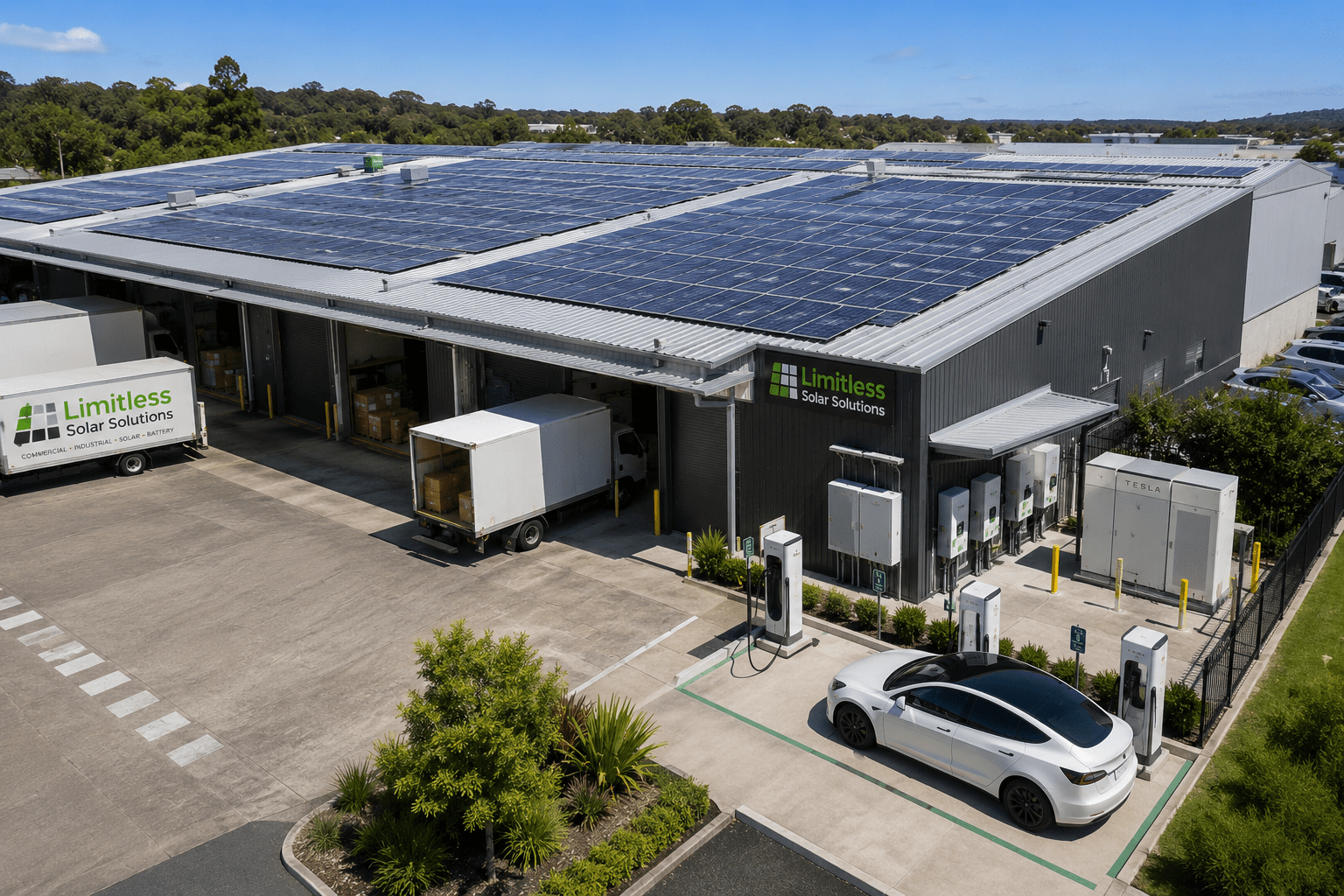
Is installing solar panels on your warehouse roof a sound investment? For businesses seeking to manage high and unpredictable electricity costs, the answer points toward significant operational benefits. A warehouse solar installation converts a substantial operational expense into a predictable, lower-cost asset. By generating your own power, you can reduce energy bills, achieve a swift return on investment, and shield your business from unstable energy markets.
This guide provides a practical framework for warehouse operators and industrial property decision-makers in Queensland. We will cover how to analyse your energy needs, assess your roof’s appropriateness, understand financial incentives, and integrate modern technologies like batteries and EV charging.
Read on to understand the strategic steps involved in making a commercially sound solar investment.
Key Takeaways
Commercial solar offers a fast return on investment and considerable savings on volatile electricity costs.
A detailed review of energy load, roof structure, and financial incentives is essential.
Integrated battery storage effectively addresses costly demand charges.
Planning for the future includes scalable systems and EV charging infrastructure.
Limitless Solar Solutions provides practical, resilient systems for Queensland’s industrial environment.
Jump to section
- Why Commercial Solar For Warehouses Is A Strategic Necessity
- Understanding Your Warehouse’s Energy Profile
- Assessing Your Roof’s Appropriateness And Structural Integrity
- Understanding Financial Incentives And Optimising Your Return
- Beyond Solar Panels: Integrating Batteries And EV Charging For Long-Term Strategy
- What To Prepare Before Your Warehouse Solar Consultation?
- Securing Your Warehouse’s Energy Future With Limitless Solar Solutions
- Frequently Asked Questions
Why Commercial Solar For Warehouses Is A Strategic Necessity
A warehouse solar system is a valuable financial tool that makes your largest, often unused asset—the roof—a source of power generation. This investment directly addresses fluctuating electricity bills, converting them into a fixed, manageable operational cost. For businesses in South East Queensland, where solar irradiance is high, the financial case is particularly strong. A properly designed system not only pays for itself but also provides reliable electricity for decades.
Beyond direct cost reductions, investing in solar power for warehouses strengthens your business’s financial health and market standing. It increases your property’s value, making it a more appealing asset for future sale or lease. Additionally, it improves your company’s sustainability credentials, a growing requirement for securing agreements with larger corporations focused on Environmental, Social, and Governance (ESG) compliance. With a typical return on investment between 3 to 7 years, warehouse solar represents a sensible capital expenditure a business can make.
How Do Solar Systems Address High Commercial Overheads?
Commercial solar panels for a warehouse roof provide a direct approach to Queensland’s varying and often costly energy market. By generating power on-site, your business lessens its reliance on the grid, effectively fixing electricity costs for the 25+ year lifespan of the system. This guards against unpredictable price increases and provides stable, predictable overheads.
The financial advantages extend beyond simple bill reduction. A commercial solar system for a commercial building typically achieves a return on investment within 3 to 7 years. After this payback period, the energy produced is essentially free, leading to significant savings over the system’s life. This capital can be reinvested into your business. A visible commitment to renewable energy also strengthens your brand’s reputation, helping you meet the strict ESG requirements of major clients. Limitless Solar Solutions designs systems that help your business meet these compliance standards while optimising your financial return.
Understanding Your Warehouse’s Energy Profile
To design an effective warehouse solar system, you must first understand your facility’s specific energy consumption patterns. A thorough analysis of your load profile, using detailed interval data, is the correct initial step. This data shows precisely when and how your warehouse uses electricity, allowing for a custom-designed solar system that maximises self-consumption and yields the greatest financial benefit.
One of the most impactful, yet often overlooked, costs on a commercial energy bill involves peak demand charges. These charges are not based on your total consumption but on the highest spike of energy usage during a billing period. A well-designed warehouse solar system, especially when paired with battery storage, can strategically manage these peaks. By understanding your specific energy profile, you can install a system that targets these particular cost drivers, leading to savings that exceed those of a basic solar installation.
What Is Your Warehouse’s Load Profile And Why Does It Matter?
Your warehouse’s load profile is a detailed record of its electricity consumption, typically measured in 15 or 30-minute intervals. Looking at a total quarterly bill only provides a partial view; analysing this interval data from your National Metering Identifier (NMI) reveals the actual pattern of your energy use. It shows when your consumption peaks, what your constant base load is, and how your usage aligns with daytime hours.
This analysis is fundamental for a successful warehouse solar project. Most warehouses have an ideal load profile, with energy consumption peaking during the day when machinery, lighting, and HVAC systems are active. This pattern aligns well with the solar generation curve, meaning a high percentage of the solar power produced can be consumed directly on-site. This self-consumption is where the greatest savings are realised. Limitless Solar Solutions uses this precise data to engineer a tailored commercial solar warehouse system, making sure it meets your specific operational demands.
“Understanding your load profile is like having a blueprint for your energy costs. Without it, you’re guessing, and that can be expensive.” – Energy Consultant, John Smith
How Do Demand Charges Affect Your Business?
Demand charges are fees applied to your bill based on the highest point of electricity consumption (measured in kVA or kW) during a specific interval. Even a single, short spike from starting heavy machinery or running large air conditioning units can set a high demand charge for the entire month. This can add thousands of dollars to your energy costs, regardless of your overall energy usage. For many warehouse operators, these charges are a considerable financial burden.
This is where peak shaving with an integrated solar and battery system becomes a substantial financial advantage. A system engineered by Limitless Solar Solutions actively monitors your facility’s energy draw from the grid. When it detects a potential consumption spike that would push you into a higher network tariff, the battery instantly discharges to cover the excess load. The grid never registers the peak, effectively “shaving” it from your bill. By analysing your detailed energy data, we can design a commercial solar energy system that specifically addresses and reduces these costly tariffs.
Assessing Your Roof’s Appropriateness And Structural Integrity
Before installing a large-scale warehouse solar system, a thorough assessment of your roof’s structural integrity is necessary. The roof must be able to safely support the static weight of the solar panels and mounting equipment, as well as endure dynamic loads like wind uplift, particularly during Queensland’s storm season. A professional engineering assessment is required to confirm compliance and long-term safety.
The type of roof, its pitch, and any potential shading from nearby structures or equipment will determine the best mounting system and panel selection. For facilities in coastal areas like the Sunshine Coast, using marine-grade components is essential to prevent corrosion and ensure the system’s longevity. A careful roof assessment confirms your solar panel installation warehouse project is built on a stable and secure foundation, protecting your investment for decades.
What Are The Key Roof Types And Mounting Systems For Warehouses?
Most modern warehouses in Queensland feature metal roofing like Corrugated Iron or Klip-Lok profiles, which are suitable for solar installations. Klip-Lok roofing is advantageous because it allows for non-penetrating clamps that attach directly to the roof’s ribs, significantly reducing the risk of water leaks. This makes the solar panels warehouse roof installation process cleaner and more secure.
For flat or low-pitch roofs, two main options exist:
Tilt frames: These angle panels towards the sun for optimal energy generation, but they add weight and wind load. This approach is often considered when maximum energy yield per panel is critical.
Flush-mounting: Panels are installed flat against the roof. This is often more cost-effective and structurally sound for a large warehouse rooftop solar array, with any slight drop in individual panel efficiency easily compensated by adding more panels. It also presents a lower profile, which can be advantageous in high-wind regions.
In Queensland’s coastal environments, Limitless Solar Solutions uses IEC 61701 Level 6 certified marine-grade panels and 316-grade stainless steel mounting systems to provide durability against salt and humidity.
What Structural And Environmental Factors Must Be Reviewed?
A comprehensive structural review is the initial step in any commercial solar project. A certified engineer must assess the building’s purlins, rafters, and overall load-bearing capacity to confirm it can handle the additional weight. This is especially important in Queensland, where installations must comply with strict wind region standards (such as Region B for high-wind coastal areas) to withstand severe storms.
The coastal Queensland environment presents particular challenges, including high humidity, strong winds, and corrosive salt air. At Limitless Solar Solutions, our SAA-accredited installers follow standards like AS 4312 Corrosivity Zone Mapping to select the correct materials and use robust sealing techniques. We also consider practical site logistics, planning for safety walkways, edge protection, and proper panel spacing. This infrastructure is vital for safe and efficient access during ongoing maintenance, preserving the longevity of your warehouse solar investment.
“A roof isn’t just a covering; it’s the foundation for your solar asset. Skipping structural checks is a false economy that can lead to significant problems down the line.” – Structural Engineer, Anna Lee.
Understanding Financial Incentives And Optimising Your Return
Understanding and applying government financial incentives is central to maximising the return on your warehouse solar investment. In Australia, federal schemes like Small-scale Technology Certificates (STCs) and tax provisions such as the Instant Asset Write-Off can notably reduce the initial capital required for a commercial solar system. This makes the financial case for solar accessible for businesses of various sizes.
For larger operations, systems with a capacity of 100kW or more can generate Large-scale Generation Certificates (LGCs). These certificates create an additional, ongoing revenue stream, further improving the long-term financial performance of the asset. Properly navigating these incentives makes a solar installation a high-performing financial instrument for your business.
How Do STCs And LGCs Benefit Commercial Systems?
The Australian government offers two main certificate-based incentives for commercial solar panels Australia, depending on system size:
Small-scale Technology Certificates (STCs): For systems up to 99.9kW, STCs provide an upfront discount on the installation cost. The value of these certificates is deducted at the point of sale, making the initial investment more manageable. For many medium-sized warehouses, a 99.9kW system offers a good balance between high energy output and this immediate financial benefit.
Large-scale Generation Certificates (LGCs): For systems 100kW and larger, the incentive structure involves LGCs. Instead of an upfront discount, LGCs are generated annually based on the actual amount of clean electricity the system produces. These certificates can then be sold on the open market, establishing an ongoing revenue stream for your business.
Limitless Solar Solutions provides the necessary technical data to help your financial advisors use these government incentives and optimise depreciation benefits for your warehouse solar project.
What Tax Incentives And Depreciation Methods Apply To Commercial Solar?
Beyond certificate schemes, important tax benefits can improve the financial feasibility of a warehouse solar installation. Depending on current Australian Taxation Office (ATO) thresholds, the Instant Asset Write-Off may allow eligible small and medium-sized enterprises to deduct the full cost of the solar system from their taxable income in the year it is installed. This can offer a substantial cash flow advantage.
If the instant write-off is not applicable, accelerated depreciation schedules still allow businesses to offset the capital outlay over a shorter period. These tax mechanisms support the idea that a commercial solar energy system is not just an operational upgrade but a strategic financial decision. It helps stabilise cash flow, protects your business against future energy market shocks, and provides a return on investment, all while potentially lowering your tax burden. Consult with your financial advisor to understand the specific implications for your business.
Beyond Solar Panels: Integrating Batteries And EV Charging For Long-Term Strategy
A modern warehouse solar strategy extends beyond simply installing panels. To truly prepare your operations for the future, integrating technologies like commercial battery storage and electric vehicle (EV) charging is necessary. These additions convert your facility from a passive energy generator into an active, intelligent energy hub, giving you more command over your costs and operational resilience — an approach aligned with the Strategic Roadmap for Adopting data-driven proactive measures in solar logistics.
Commercial batteries are crucial for accessing the full potential of your solar array, particularly for managing peak demand charges and confirming business continuity during grid outages. At the same time, installing EV charging infrastructure powered by your solar system readies your business for the move to electric fleets. This positions your warehouse as a self-sufficient and forward-thinking operation.
Can Commercial Batteries Address Peak Demand?
Yes, commercial battery storage is an effective method for managing and often reducing costly peak demand charges. By installing a 30kWh+ commercial battery system from Limitless Solar Solutions, you can implement a peak shaving strategy. The system’s smart software monitors your energy consumption in real-time and, when it detects a sudden demand spike, the battery instantly discharges power to meet that need — a capability underpinned by reinforcement learning approaches to warehouse energy management, such as those explored in the Storehouse: a Reinforcement Learning environment for optimising warehouse management. This prevents you from drawing expensive power from the grid during peak times, directly reducing your monthly bill from providers like Energex.
Beyond peak shaving, batteries allow for energy arbitrage, where you store excess, lower-value solar energy generated during the day and use it during evening peak tariff periods or to power night-shift operations. Furthermore, we can engineer your system to provide Uninterruptible Power Supply (UPS) capabilities. During a blackout, the system automatically disconnects from the grid and powers your critical loads, like cold storage or IT servers, providing operational continuity.
Why Consider EV Charging with Your Solar System?
Integrating EV charging with your warehouse solar system is a strategic decision that addresses the rising costs of both electricity and transportation fuel. It allows you to power your company’s fleet of delivery vans, forklifts, or staff vehicles with clean, cost-effective energy generated directly from your roof. This creates a strong relationship that significantly reduces operational expenditures and reinforces your commitment to sustainability.
Modern commercial EV chargers feature dynamic load balancing. This smart technology makes sure that vehicles are charged using only available excess solar power, preventing you from drawing expensive electricity from the grid or exceeding your site’s import limits. As vehicle-to-grid (V2G) technology becomes more common, your EV fleet could even act as a distributed battery, further improving your energy management capabilities. Limitless Solar Solutions designs and installs integrated EV charging infrastructure, helping prepare your warehouse operations for the future and improve your brand image.
What To Prepare Before Your Warehouse Solar Consultation?
To make sure a consultation for your warehouse solar project is productive and efficient, gathering some key information beforehand is very helpful. Having access to detailed energy bills and a basic understanding of your operational load patterns will allow for a more accurate initial system design and quote. This preparation helps our team understand your specific needs from the outset.
Additionally, thinking through practical site considerations will streamline the assessment process. This includes reviewing roof access points, the current state of your electrical switchboards, and any relevant tenancy agreements if you lease the property. Proactive preparation helps identify potential challenges early and makes sure the subsequent site visit and proposal are as accurate and complete as possible.
What Information Do You Need to Provide for an Accurate Quote?
To create a precise and effective warehouse solar proposal, our team requires a few key pieces of information. Gathering these items before our consultation will help move the process forward:
Energy Consumption Data: Your most recent 12 to 24 months of electricity bills are necessary. Providing your NMI (National Metering Identifier) allows us to access your detailed interval data for a thorough load profile analysis, which is critical for accurate sizing.
Site and Roof Information: Any available architectural drawings or roof schematics are very helpful. Knowing the roof material (e.g., Klip-Lok, corrugated iron), its age, and its general condition is also important for structural assessment and mounting system selection.
Operational Details: A summary of your business hours, peak production times, and any planned future expansions, such as adding new heavy machinery or transitioning to an EV fleet, will help us design a scalable system.
Electrical Infrastructure: Information about your main switchboard, available spare capacity, and the age of your electrical infrastructure is important for grid connection and system integration.
Property Ownership/Tenancy: Whether you own the property outright or lease it is crucial. If leased, a copy of your tenancy agreement or a clear understanding of your lease terms regarding roof modifications is required. Landlord approval is a mandatory step.
Business Details: Your ABN, the legal entity name, and contact details for the key decision-makers within your organisation will be needed for the formal proposal.
What Common Mistakes Should Warehouse Operators Avoid?
When planning a warehouse solar installation, several common oversights can lead to less-than-optimal outcomes. Avoiding these pitfalls will help you acquire a reliable, compliant, and high-performing system.
Overlooking Demand Charges: A frequent error is focusing only on the total kWh consumption on a bill. Demand charges can be a significant cost, and Limitless Solar Solutions addresses this by designing systems with targeted battery storage solutions to perform “peak shaving.”
Neglecting Structural Integrity: Skipping a professional structural engineering assessment is a notable risk. Confirming your roof can safely bear the load is a step that protects your property and your people.
Ignoring Future Needs: A system designed only for today’s needs may be insufficient tomorrow. We support planning for scalability from the start, allowing for easy expansion to accommodate EV charging or increased energy demand in the future.
Not Reviewing Tenancy Agreements: For leased properties, failing to get explicit landlord approval and understanding lease clauses regarding modifications can lead to delays or disputes. Address this early.
Underestimating Switchboard Capacity: The existing electrical switchboard might not have the spare capacity or the correct type of mains protection for a large solar installation. An initial electrical assessment is necessary to avoid costly upgrades or delays.
Voiding Warranties Due to Lack of Maintenance: High-quality solar panels come with 25-year manufacturer warranties, but these often require documented maintenance. Neglecting professional cleaning can void these warranties. Limitless Solar Solutions offers SAA-accredited inspections and our specialised “Freshwater Flush” service to preserve both your warranty and system efficiency.
Securing Your Warehouse’s Energy Future With Limitless Solar Solutions
Making the move to commercial solar is one of the most significant financial and operational decisions you can make for your warehouse. It provides substantial savings, offers budget certainty, and shows a strong commitment to sustainability. A well-designed warehouse solar system is a valuable asset that strengthens your business.
At Limitless Solar Solutions, we specialise in creating practical, resilient energy systems for Queensland’s industrial environment. Our in-house team of experts manages every detail, from detailed energy analysis and structural engineering to smooth installation and ongoing maintenance. We are committed to helping your business achieve greater energy independence.
Contact us today to schedule a comprehensive site assessment and discover your facility’s full solar potential.
Frequently Asked Questions
Question: What is the typical payback period for commercial solar in Queensland?
The payback period for a commercial solar system in Queensland is typically between 3 to 7 years. This timeframe can vary based on your energy consumption patterns, system size, and the specific government incentives you use. After this period, your business benefits from over 20 years of significantly reduced energy costs.
Question: What are “demand charges” and how does solar address them?
Demand charges are fees based on the highest spike of energy your facility draws from the grid during a billing cycle. A warehouse solar system paired with an integrated battery can perform “peak shaving,” using stored energy to cover these spikes. This prevents you from being placed in a higher tariff tier and lowers your bills.
Question: Are there specific solar panel requirements for Queensland’s coastal environment?
Yes, the salt-laden air in coastal Queensland requires resilient components. We recommend using marine-grade panels (IEC 61701 Level 6 certified) and 316-grade stainless steel mounting systems to prevent corrosion and ensure system longevity. Limitless Solar Solutions specialises in designing and installing these durable, compliant systems for coastal properties.
Question: Can a warehouse solar system provide power during a grid blackout?
A standard grid-tied solar system will not operate during a blackout. However, a system integrated with battery storage and configured for “blackout protection” can. These systems automatically and safely disconnect from the grid, allowing your critical business loads, such as refrigeration or IT servers, to remain fully operational.
Question: How do government incentives for commercial solar work for businesses over 100kW?
Systems larger than 100kW are eligible for Large-scale Generation Certificates (LGCs) instead of the upfront STC discount. LGCs are generated based on the actual amount of renewable electricity your system produces. These certificates can be traded on an open market, creating an ongoing revenue stream for your business.
Question: How does Limitless Solar Solutions ensure system longevity and efficiency?
We ensure longevity through three key areas: using premium, Tier 1 components suited for Queensland’s climate, employing our in-house SAA-accredited installers for quality control, and offering tailored commercial maintenance plans. Our services, including professional cleaning and our signature “Freshwater Flush,” preserve manufacturer warranties and maintain peak system performance.