

Receiving multiple commercial solar quotes can be overwhelming, making it difficult to determine if you are getting a fair deal. To properly compare commercial solar quotes, you must look beyond the final price. A genuine comparison involves dissecting an itemised breakdown of costs, assessing the quality of proposed panels and inverters, and verifying the installer’s credentials and local reputation.
It also requires confirming that the system design is customised to your business’s specific energy consumption patterns. Only by evaluating these factors can you confirm you are securing a high-value, long-term asset, not just a low initial price.
This guide provides a practical framework for this evaluation. We will walk through each component of a quality solar proposal, helping you make a confident and informed investment decision for your business.
Key Takeaways
Look beyond the headline price for true value.
Prioritise itemised quotes, quality components, and accredited installers.
Confirm the system is custom-sized for your business’s unique energy profile.
Factor in long-term return on investment, financing options, and future scalability.
Verify warranties and local after-sales support for peace of mind.
Jump to section
- Deconstructing Your Commercial Solar Quote: What to Expect and Why Transparency Matters
- Beyond The Headline Price: Evaluating System Design And Equipment Quality
- The Installer Factor: Why Expertise And Reputation Matter Most
- Sizing For Success: Matching Solar To Your Business’s Energy Needs
- Maximising Your Investment: Understanding Financials And Long-Term Value
- Future-Proofing Your Business: Integrating Batteries And EV Charging
- Making An “Apples-To-Apples” Comparison: A Practical Checklist
- Invest In Smart Solar For Your Business With Confidence
- Frequently Asked Questions
Deconstructing Your Commercial Solar Quote: What to Expect and Why Transparency Matters
Understanding the details of your commercial solar quote is the first step in a fair comparison process. A high-quality proposal will always provide a granular, itemised breakdown of all costs, rather than just a single lump-sum figure. This transparency is not just good practice; it is essential for you to see exactly where your investment is going and to compare different offers on a like-for-like basis.
Knowing the specifics of the equipment, installation charges, and potential additional fees is vital for avoiding hidden costs that can inflate your budget later on. A transparent quote empowers you to ask the right questions and identify providers who prioritise value and honesty over a quick sale. It allows you to compare commercial solar quotes based on substance, not just a number on a page.
What Should Be In An Itemised Solar Quote?
A detailed quote should clearly separate the costs of all core components, providing the clarity needed for an honest and accurate assessment of different proposals for your business. It should specify:
Solar panels and inverters: Brand, model number, quantity, and cost for each. It should also explain the proposed inverter technology (e.g., string inverters, micro-inverters, or power optimisers) and its suitability for your commercial system.
Installation and labour charges: A clear breakdown. For commercial facilities, this may include complex logistics like crane hire or specialised roof mounting. These costs should be transparent, reflecting the work of qualified, SAA-accredited professionals.
Balance of System (BoS) components: Mounting hardware, cabling, and any necessary switchboard upgrades. Quality BoS parts are fundamental to long-term safety and performance.
How Do Government Incentives And Hidden Costs Impact The Price?
Government incentives and potential hidden fees significantly influence the final price of a commercial solar installation. A transparent quote must clearly present how these factors affect your total financial outlay.
For systems under 100kW in Australia, the federal Small-scale Technology Certificates (STCs) provide a substantial upfront discount. Your quote should explicitly show this as a point-of-sale deduction from the total cost. Additionally, projections should factor in feed-in tariffs (FiTs), which are the credits you receive for exporting excess energy back to the grid.
A trustworthy provider will also discuss potential hidden costs upfront. These can include structural roof engineering assessments, local network provider grid connection fees (such as from Energex in Queensland), and any major switchboard upgrades. At Limitless Solar Solutions, we confirm these potential extra costs are discussed early to provide a complete financial picture.
Beyond The Headline Price: Evaluating System Design And Equipment Quality
When you compare commercial solar quotes, it’s important to look past the initial cost and focus on the long-term value. The technical specifications of the solar panels, inverters, and any battery systems directly influence the savings and reliability of your commercial installation over its 25-plus year lifespan. Choosing higher-quality components often leads to better performance and a stronger return on investment.
Equally important is the system design itself. A superior design, based on an accurate, site-specific analysis, will optimise energy generation for your unique operational needs. A generic, one-size-fits-all approach will almost certainly underperform, diminishing your potential savings. A custom-tailored system confirms maximum efficiency and aligns the solar generation with your business’s consumption patterns.
What Solar Panel And Inverter Technologies Should You Look For?
Selecting high-quality and durable solar components is essential for achieving optimal performance in the Australian climate. When reviewing quotes, compare panels based on their efficiency rating. Panels with efficiency over 21-22% are ideal for businesses with limited roof space, as research on the efficiency of vertically installed and angled PV configurations confirms that panel orientation and efficiency ratings significantly affect real-world output. Also, consider the annual degradation rate; modern N-type silicon panels, for instance, degrade much slower, providing higher output for longer, as demonstrated by studies on the performance and aging of long-term silicon PV systems.
Your quote should also specify reputable inverter brands like Enphase or Sungrow, confirming their suitability for a commercial-scale project. For businesses planning future growth, a scalable inverter architecture is a smart investment. Finally, confirm the proposed hardware is built to withstand Queensland’s demanding climate, including high humidity, intense UV exposure, and severe storms. This resilience is a key indicator of long-term system reliability.
Why Is Site-Specific System Design Critical For Commercial Operations?
A custom-designed solar system is fundamental for maximising returns, and generic quotes are a major red flag. A proper design process begins with a detailed energy consumption analysis, using 12 months of your interval meter data to map power usage, an approach validated by Frontiers | Design, techno-economic research on grid-connected rooftop solar systems for commercial buildings. This allows the system to be sized to align solar generation directly with your business’s operational loads.
Advanced providers like Limitless Solar Solutions use technologies such as LiDAR mapping and detailed shading analysis. This creates a design based on precise, site-specific data, accounting for rooftop obstacles like vents and HVAC units. The goal is to optimise for self-consumption, which means maximising the direct use of the solar power you generate. This approach significantly reduces your reliance on expensive grid electricity and cuts down on peak demand charges.
The Installer Factor: Why Expertise And Reputation Matter Most
The best solar equipment in the world will underperform if it is not installed correctly. The quality of the installation directly affects system performance, safety, and the validity of your warranties, making the installer’s credentials and reputation the most important factors to consider. A well-executed installation helps confirm your system operates efficiently and safely for decades.
Choosing a local, in-house team with a proven track record provides superior accountability and responsive after-sales support. Subcontracted labour can introduce inconsistencies in quality and communication, whereas a dedicated team provides a seamless process from design to commissioning. When you compare commercial solar quotes, the company behind the installation is just as important as the hardware itself.
What Accreditations And Experience Should A Commercial Solar Installer Have?
When evaluating installers, certain qualifications are non-negotiable for a reliable and compliant installation. The most important is SAA (Solar Accreditation Australia) accreditation, which serves as a baseline for quality and safety. At Limitless Solar Solutions, we confirm our entire installation team is SAA-accredited.
Beyond this, look for installers with a proven commercial track record. They should have specific experience in executing complex deployments and adhere to robust safety protocols. It is also beneficial to choose a company that uses its own in-house teams instead of subcontractors. This approach helps maintain consistent quality, clear communication, and direct accountability from the engineering phase all the way through to energisation.
Why Does Local Support And Aftercare Matter For Your Business?
A local presence and comprehensive after-sales support are essential for protecting the long-term value of your solar investment. A company with a physical footprint in your area, such as Limitless Solar Solutions on the Sunshine Coast and in North Brisbane, can provide rapid diagnostics, maintenance, and warranty support when needed.
Ongoing performance monitoring and commercial solar health checks are also valuable services that protect your return on investment. A good provider will offer these to confirm your system continues to perform optimally. Your product, performance, and workmanship warranties are only as good as the company that backs them. An established local installer helps confirm your warranties remain valid and that any claims are managed efficiently.
Sizing For Success: Matching Solar To Your Business’s Energy Needs
Correctly sizing your solar system is fundamental to maximising its financial and operational benefits. A system that is too small will not make a meaningful impact on your electricity bills, while an oversized one can lead to an unnecessary initial investment. The key is to find the right balance based on a detailed analysis of your business’s energy data.
A high-quality commercial solar quote will do more than just meet your current energy demands; it will also provide a clear pathway for future scalability, as mapping Europe’s rooftop photovoltaic potential research demonstrates the vast untapped capacity in commercial building solar deployment globally. As your business grows, your energy needs will likely change. A forward-thinking system design helps confirm your solar investment can grow with you, providing lasting value for years to come.
How Do You Determine The Right Commercial Solar System Size?
Accurately sizing a commercial solar system begins with detailed load profiling. This involves analysing 12 months of your high-frequency interval meter data to precisely match the solar generation curve with your facility’s energy usage patterns. The focus should be on offsetting your daytime operational loads to maximise self-consumption.
This data-driven approach is particularly effective at reducing peak demand charges, which can be a substantial cost for many businesses. System size thresholds are also a consideration; commercial systems often range from 30kW up to 99kW to remain within the STC rebate framework. Exceeding these thresholds may require more complex network studies, so a knowledgeable installer can guide you on the optimal size for your circumstances.
Can Your Commercial Solar System Grow With Your Business?
A well-designed commercial solar system should absolutely be able to grow with your business. Emphasising a scalable design philosophy from the outset is a smart long-term strategy. This allows for future additions like battery storage, EV charging stations, or more solar panels as your energy needs evolve.
This flexibility allows your system to adapt to changes in energy consumption, whether from business expansion or the adoption of new electric machinery. Investing in a scalable system helps future-proof your business against rising energy costs and changing operational demands. At Limitless Solar Solutions, designing for future growth is a core part of our commercial offering, confirming your system remains a valuable asset for years to come.
Maximising Your Investment: Understanding Financials And Long-Term Value
For any business, a commercial solar system is a significant financial decision. Therefore, a rigorous assessment of the projected returns is essential. When you compare commercial solar quotes, you need to analyse the payback period, financing options, and the impact of government incentives to understand the full financial picture.
A sound investment goes beyond a low upfront cost. Understanding the various financing options available can significantly improve your cash flow and overall return on investment. A good solar provider will act as a consultant, helping you navigate these financial aspects to confirm the solar system aligns perfectly with your business’s financial strategy.
What Financial Metrics Should You Compare In Commercial Solar Quotes?
When scrutinising solar proposals, several key financial indicators will help you make an informed decision. The payback period is a primary metric, estimating the time it will take for your energy savings to cover the initial investment. Be wary of quotes that promise unrealistically short payback periods without providing clear, conservative assumptions.
Another useful metric is the Levelised Cost of Energy (LCOE), which calculates the true cost per kilowatt-hour of solar energy over the system’s lifespan, a methodology examined in depth in techno-economic comparison of emerging solar PV modules for utility and commercial-scale installations. This allows for a direct comparison with your current grid electricity rates. Finally, look for detailed cash flow projections that account for current tariffs, peak demand charges, and projected energy price inflation to get a realistic view of future savings.
How Do Financing Options And Incentives Affect Your Solar ROI?
The way you fund your solar project can significantly influence its financial returns. There are several financing pathways, including an outright purchase (Capital Expenditure), business loans, asset finance, solar leases, or Power Purchase Agreements (PPAs). Each option has different implications for cash flow and long-term savings, and a provider like Limitless Solar Solutions can offer guidance on what works best for your business.
Government incentives also play a large part. The federal STC program provides an upfront discount for systems under 100kW, while feed-in tariffs offer ongoing credits. Highlighting a free, no-obligation ROI analysis as part of a Commercial Solar Assessment is the mark of a provider committed to financial transparency.
Future-Proofing Your Business: Integrating Batteries And EV Charging
Modern commercial solar systems offer much more than just energy generation. Integrating advanced technologies like battery storage and electric vehicle (EV) charging can increase the long-term value of your investment and position your business as a forward-thinking leader. These additions provide greater energy independence and prepare your operations for the future of energy and transport.
When you compare commercial solar quotes, look for providers who can seamlessly integrate these future-focused options. A scalable system that accommodates these technologies confirms your investment remains relevant and continues to deliver value as energy markets and business needs evolve.
Why Consider Battery Storage For Your Commercial Solar System?
Integrating battery storage with your solar system offers significant benefits for businesses. It promotes energy independence by storing excess solar power generated during the day for use during evening peak tariff periods. This practice, known as “peak shaving,” can drastically reduce your electricity bills by lowering expensive demand charges.
Furthermore, batteries provide essential backup power, confirming your essential operations can continue during grid outages. This resilience provides valuable business continuity. Leading brands like Tesla Powerwall 3, Enphase, and Sungrow offer reliable options. A scalable system design allows you to add battery storage at a later date if it is not part of your initial installation.
How Can EV Charging Integration Benefit Your Business?
Incorporating EV charging stations into your commercial solar setup offers several strategic advantages. It allows you to use your self-generated solar power to reduce transport costs for fleet vehicles. It also serves as a valuable amenity for staff and customers, attracting and retaining environmentally conscious individuals.
This visible commitment to sustainability can improve your brand’s reputation, providing a growing competitive advantage. It also prepares your business for the inevitable increase in EV adoption by employees and clients. Many commercial clients of Limitless Solar Solutions are already integrating EV infrastructure to future-proof their properties and operations.
Making An “Apples-To-Apples” Comparison: A Practical Checklist
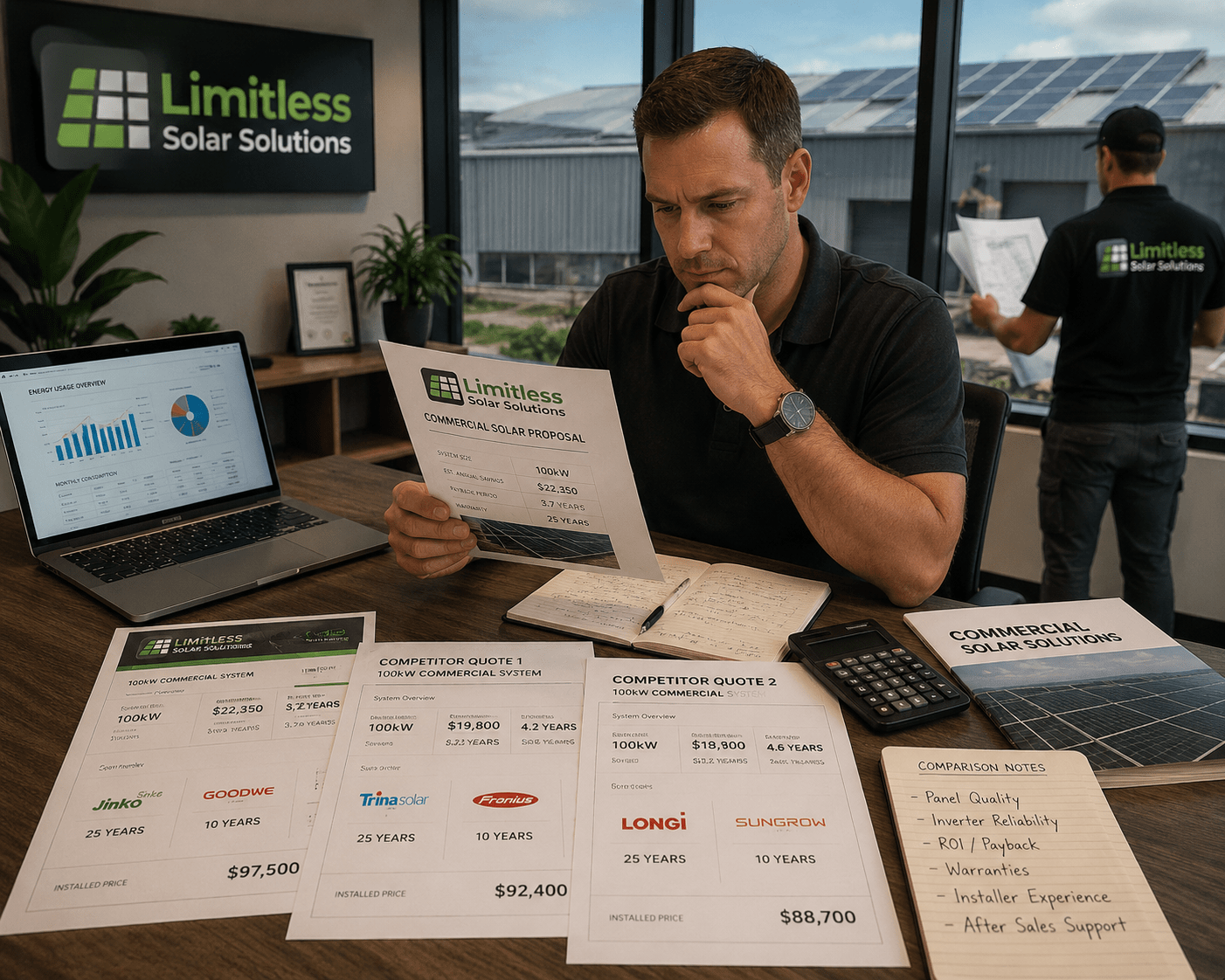
To accurately compare commercial solar quotes, you need a methodical approach. Because proposals can vary widely in what they include, standardising metrics and carefully scrutinising assumptions is the only way to identify true value. A simple price comparison is often misleading and can lead to a poor long-term investment.
Using a structured checklist helps you focus on the key elements that define a high-quality solar system. This process empowers you to move beyond the sales pitch and make an informed decision based on quality, performance, and long-term reliability. It confirms you select a partner and a system that will deliver results for your business for years to come.
Your Commercial Solar Quote Comparison Checklist
Use this practical checklist to evaluate competing commercial solar proposals and make a confident decision.
Verify Itemisation: Does each quote provide a detailed breakdown of panels, inverters, mounting, labour, BoS, and any extras? A single lump sum is a red flag.
Equipment Consistency: Are the proposed panel and inverter brands and models consistent across quotes? Confirm you are not comparing premium equipment with entry-level options.
Installer Credentials: Is the installer SAA-accredited? Do they use their own in-house teams or rely on subcontractors? Check their local presence and reputation in areas like the Sunshine Coast or North Brisbane.
System Sizing Rationale: Is the proposed system size clearly justified by your actual energy usage data? A quality quote bases its design on your specific business operations.
Warranty Clarity: Are the product, performance, and workmanship warranties clearly outlined? Verify their duration and the stability of the company backing them.
Financial Projections: Are the payback period and ROI analysis presented with realistic assumptions about energy rates and self-consumption? A free ROI analysis, like that offered by Limitless Solar Solutions, adds trustworthiness.
Hidden Costs: Are potential additional costs, such as switchboard upgrades or grid connection fees, discussed transparently upfront?
Scalability & Future Options: Does the quote consider your future needs, such as battery storage or EV charging? A scalable design is a smarter investment.
Transparency & Communication: Does the provider act as an energy consultant, helping you understand what you are comparing, rather than just pushing a sale? This consultative approach is a core value at Limitless Solar Solutions.
Invest In Smart Solar For Your Business With Confidence
To effectively compare commercial solar quotes, you must look beyond the initial price to assess system quality, custom design, installer expertise, and long-term value. A methodical evaluation is the only way to confirm your investment delivers predictable energy costs, improves your sustainability credentials, and provides a strong return. An informed decision today protects your business from volatile energy prices tomorrow.
For businesses on the Sunshine Coast and in North Brisbane ready to proceed with their energy future, the next step is simple. Contact Limitless Solar Solutions for a FREE, no-obligation Commercial Solar Assessment and a detailed ROI analysis to start your process.
Frequently Asked Questions
Question: What Are The Main Red Flags To Look For In A Commercial Solar Quote?
Answer: Key red flags include unusually low prices, vague equipment details, missing warranty information, and a lack of SAA accreditation. High-pressure sales tactics are also a warning sign. At Limitless Solar Solutions, we educate clients on how to spot these issues.
Question: Is A Commercial Solar System A Good Investment For A Small Business In Australia?
Answer: Yes, it is a strategic financial decision for many Australian SMEs. Commercial solar typically offers a strong ROI with a payback period of 2.5-5 years, reduces operating costs, stabilises energy expenses, and improves your brand’s reputation.
Question: What Is SAA Accreditation, And Why Is It Important When Comparing Installers?
Answer: SAA (Solar Accreditation Australia) accreditation shows that an installer meets strict national quality and compliance standards. It is a non-negotiable credential for commercial solar projects, to confirm your system is installed safely and effectively. The team at Limitless Solar Solutions is fully SAA-accredited.
Question: How Do Commercial Solar Financing Options Like PPAs Work, And Are They Beneficial?
Answer: Power Purchase Agreements (PPAs) let businesses install solar with zero upfront cost by paying for the generated electricity at a fixed rate. They can be good for cash flow but require careful comparison with options like asset finance, which Limitless Solar Solutions can advise on.
Question: How Long Do Commercial Solar Panels Typically Last, And What Warranties Should I Expect?
Answer: High-quality commercial solar panels can last 25-30 years, a figure supported by performance and aging of 20-year silicon PV systems, which confirms sustained energy output well into a system’s third decade. Their performance warranties typically guarantee 85-89% of their original output at year 25. Expect separate product, performance, and workmanship warranties from a reputable installer like Limitless Solar Solutions.