
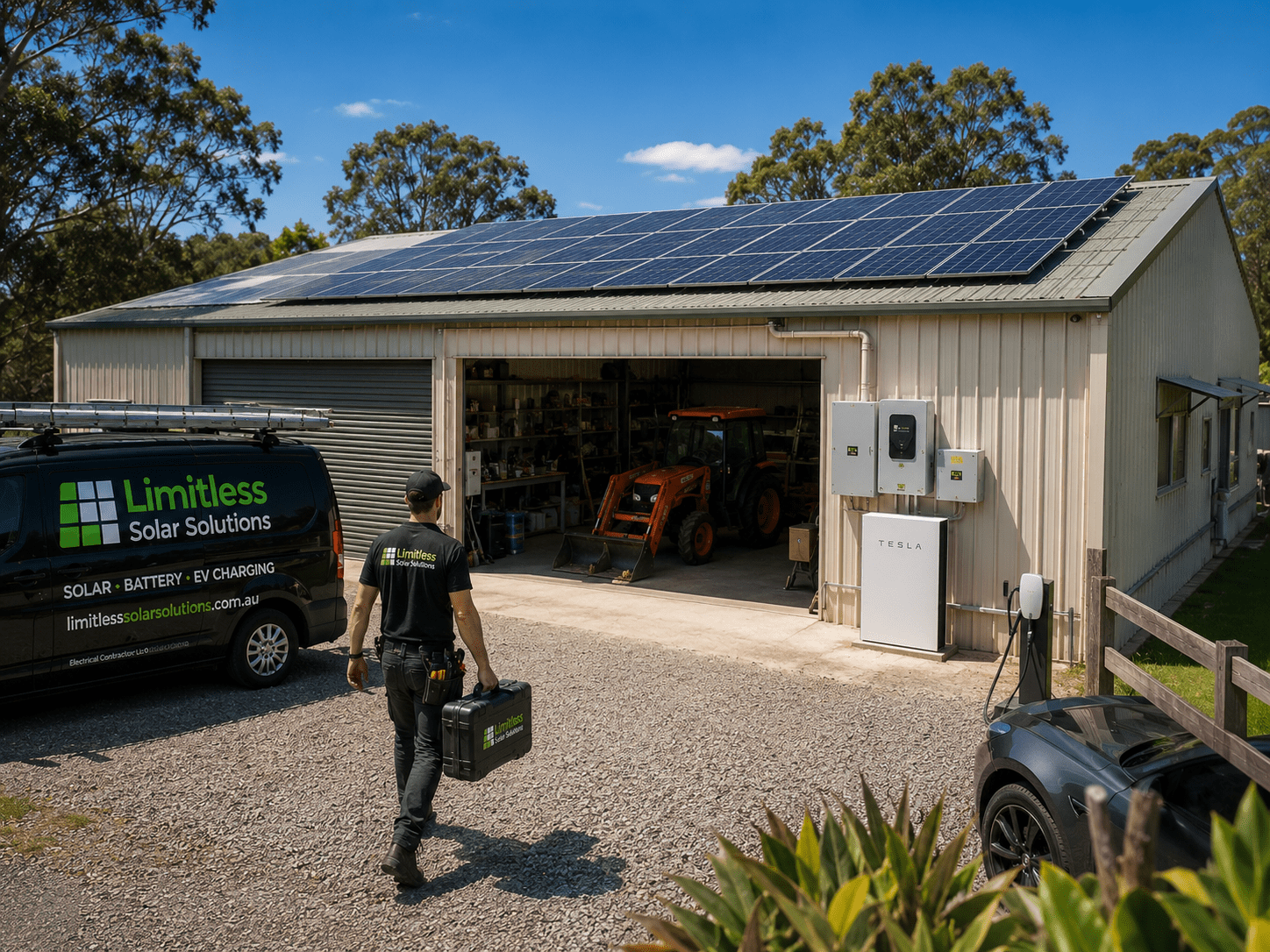
Adding solar for sheds is a smart way to turn unused roof space into reliable power for a garden shed, workshop, farm building or outbuilding. Whether you want to run lights, tools, pumps, batteries or off-grid equipment, the right solar setup can reduce electricity costs, improve energy independence and make your Queensland property more practical year-round.
Key Takeaways
-
Sheds and outbuildings offer ideal, often un-utilised, roof space for significant solar generation.
-
Custom-designed solar systems reduce electricity bills, improve energy independence, and offer blackout protection.
-
Proper assessment of structural integrity, energy needs, and local regulations is essential for successful installation.
-
Advanced options like battery storage and EV charging can convert outbuildings into energy hubs.
-
Government incentives and expert local installation make solar for sheds a smart investment for Queensland properties.
Jump to section
- Why Consider Solar for Your Shed, Workshop, Or Farm Outbuilding?
- Assessing Your Outbuilding’s Suitability For Solar Power
- Designing The Right Solar System: Grid-Tied, Off-Grid, Or Hybrid?
- Maximising Performance: Battery Storage, EV Charging, And Advanced Features
- Solar For Commercial And Agricultural Operations: A Strategic Investment
- Navigating Approvals, Incentives, And Long-Term System Care
- Powering Your Future With Solar For Your Outbuildings
- Frequently Asked Questions
Why Consider Solar for Your Shed, Workshop, Or Farm Outbuilding?
Considering solar for your secondary structures is a practical step toward energy independence and substantial cost savings. Sheds, workshops, and farm outbuildings often feature large, unobstructed roof planes, making them perfect candidates for powerful solar arrays. By converting this unused space into a power-generating asset, property owners across Queensland can offset high electricity costs associated with power tools, irrigation pumps, or commercial equipment. This approach not only lowers your utility bills but also increases your property’s resilience and value, supported by Report Global Electricity Review 2025.Pdf, which confirms clean power now exceeds 40% of global electricity generation.
The versatility of these outbuildings allows for highly individually designed solar systems. A system can be designed specifically for the heavy loads of a workshop, the continuous needs of farm infrastructure, or simply to maximise the solar potential of your entire property. Whether you are aiming for complete off-grid autonomy or a grid-connected system that feeds excess power back to your main home, installing solar for sheds and other outbuildings is a strategic move. It positions your property for a future where energy efficiency and self-sufficiency are paramount.
Unlocking Energy Independence And Cost Savings
Installing a solar system on your workshop or farm shed directly tackles high operating costs. Power-hungry equipment like welders, air compressors, and refrigeration units can be run using clean energy generated on-site, making a noticeable impact on your electricity bills. For rural properties in Queensland, where the grid can be less reliable, a solar setup with battery storage provides vital backup power, allowing your operations to continue uninterrupted during outages. This is where a custom-designed system from Limitless Solar Solutions makes all the difference, making sure you have power when you need it most.
For structures located far from the main switchboard, an off-grid solar power for outbuildings system eliminates the often prohibitive cost of trenching and extending the grid connection. This capability grants full energy independence for remote workshops or farm buildings. Furthermore, integrating a battery provides Uninterruptible Power Supply (UPS) functionality, protecting essential equipment during grid failures. A property featuring a comprehensive solar setup is not only more efficient but also more attractive on the real estate market, representing a significant long-term investment.
Why Local Expertise Matters In Queensland?
Choosing the right installer is just as important as selecting the right hardware, especially in Queensland’s specific climate. A local expert possesses deep knowledge of regional conditions, from the intense summer heat to the specific requirements of network operators like Energex and Ergon. This understanding confirms your system is designed for durability and peak performance year-round. An experienced local team navigates Queensland building codes and regulations with ease, leading to a smooth and compliant installation process from start to finish.
At Limitless Solar Solutions, we pride ourselves on our local expertise and our commitment to quality. We never subcontract our work; our in-house team of Solar Accreditation Australia (SAA)-accredited installers manages every project. This guarantees accountability and a consistently high standard of workmanship. We design every system around your specific needs, whether it’s for a home workshop on the Sunshine Coast or large-scale farm infrastructure in North Brisbane. The result is a low-maintenance, reliable solar system that delivers value for decades.
Assessing Your Outbuilding’s Suitability For Solar Power
A successful solar installation begins with a thorough assessment of your outbuilding’s suitability. Before panels are mounted, it is necessary to conduct rigorous checks on the structure’s integrity and environmental conditions to confirm safety, compliance, and long-term efficiency. Not all sheds are built to the same standard, so a professional evaluation is a non-negotiable first step in the process.
Understanding key factors like the roof’s pitch, its orientation relative to the sun, and any potential shading from nearby trees or buildings is fundamental to designing an effective system. These elements directly influence how much energy your panels can generate. A comprehensive site assessment identifies any potential challenges early on, allowing for a solar design that maximises your return on investment and guarantees a safe, durable installation for years to come.
What Structural Integrity And Wind Load Considerations Are Necessary For Sheds?
Confirming your shed can safely support a solar array is the first priority. A professional assessment involves reviewing the shed’s engineering certificate to confirm that its trusses and purlins can handle both the static weight of the panels (dead load) and the significant upward force created by wind (live load). This is particularly important in coastal areas like the Sunshine Coast, which are subject to stringent wind ratings (Wind Region B or C). In some cases, structural upgrades such as additional cyclone battens may be necessary to meet Australian Standards.
The condition of your roofing material also plays a key role. Most sheds use corrugated iron or trapezoidal steel, which are excellent for mounting solar panels. However, the roofing must be checked for any rust, corrosion, or weakness. Installing a 25-year solar system on a roof that needs replacing in five years is not a sound investment. The thorough site assessments conducted by Limitless Solar Solutions cover all these structural checks, making certain your shed provides a safe and secure foundation for your new solar system.
How Do Roof Pitch, Orientation, And Shading Impact Solar Efficiency?
To maximise energy generation, a solar system for shed roofs in South East Queensland should ideally be oriented north at a pitch between 15 and 28 degrees. This angle optimises sun exposure and helps panels self-clean during rainfall. Many sheds have low-pitch roofs, but this is rarely a deal-breaker; panels can be mounted on tilt frames or flush-mounted, with the latter option still providing excellent efficiency while reducing wind load. A common gable roof facing east and west can also be highly effective, as a split array captures morning and afternoon sun, aligning perfectly with periods of high energy use in a workshop.
A detailed shading analysis is another important step. Shadows cast by nearby houses, sheds, or large trees can severely reduce a system’s output, especially during the lower sun angles of winter. Using specialised solar pathfinding tools, installers can map out how shadows will affect the roof throughout the day and across the seasons. This analysis informs the optimal panel layout. Limitless Solar Solutions specialises in designing high-performance systems even for challenging locations, making sure you get the most out of your investment regardless of your property’s specific conditions.
Designing The Right Solar System: Grid-Tied, Off-Grid, Or Hybrid?
Choosing the right type of solar system for your outbuilding is a key decision that impacts cost, functionality, and your level of energy independence. The best design depends on your shed’s distance from the main house, your specific energy consumption patterns, and your long-term goals. Each system type—grid-connected, off-grid, or hybrid—offers distinct advantages and requires careful planning to address technical considerations.
Successfully installing solar panels for shed roof areas, especially those far from a primary dwelling, involves overcoming specific engineering challenges. Factors like voltage drop over long cable runs and selecting the right inverter for Queensland’s harsh environment are important for confirming your system operates efficiently and complies with Australian Standards. A well-designed system will provide reliable power for decades, making it a valuable addition to your property.
Understanding Grid-Connected Vs. Off-Grid Vs. Hybrid Systems
The three main types of solar systems for outbuildings each serve a different purpose.
-
Grid-Tied Systems: This is the most common setup, where your shed’s solar array is connected to the grid via your main switchboard. Power generated is first used by the shed and house, with any surplus exported for a feed-in tariff. This is a cost-effective choice for sheds located close to the main dwelling but depends on the cost of trenching for underground cables.
-
Off-Grid Solar Systems: For remote sheds or large rural properties, an off-grid system provides complete energy autonomy. It combines solar panels with battery storage and a dedicated inverter to create a self-sufficient microgrid. This option, a speciality of Limitless Solar Solutions, avoids the massive expense of extending the grid over long distances.
-
Hybrid Systems: A hybrid system offers the best of both worlds. It is connected to the grid but also includes a battery. This allows you to store excess solar energy for use at night or during a blackout, maximising self-consumption and providing a reliable backup power source.
Navigating Technical Challenges: Cabling, Voltage Drop, And Inverter Selection
Installing solar on a detached outbuilding presents specific technical hurdles. One of the main challenges is voltage drop, where electrical resistance over long underground cables can cause the system to lose efficiency or trip off. According to Australian Standards, this must be carefully calculated and managed by using thicker, high-quality cabling to confirm compliance and reliable performance. The required trenching for this conduit must also meet strict depth and safety standards.
Inverter placement is another consideration in Queensland’s climate. An uninsulated steel shed can get extremely hot, and high temperatures can cause an inverter to reduce its power output to protect itself. Inverters should be installed in a shaded, well-ventilated location, and units with high Ingress Protection (IP) ratings are recommended for dusty environments like workshops. Depending on the size of the new solar power kit for shed with battery, your existing sub-board or main switchboard may also require an upgrade, a process that Limitless Solar Solutions manages seamlessly.
Maximising Performance: Battery Storage, EV Charging, And Advanced Features
A basic solar setup is a great start, but integrating modern technologies can convert your outbuilding into a sophisticated energy hub. By adding battery storage and electric vehicle (EV) charging, you can dramatically increase the utility and financial return of your system. These features not only help you use more of the free energy you generate but also prepare your property for the future of energy and transport.
Advanced components like micro-inverters and smart monitoring systems further boost efficiency and provide you with complete control over your energy production and consumption. A well-designed system should be scalable, allowing you to easily add more panels or batteries as your needs grow. This forward-thinking approach confirms your investment remains valuable for its entire 25+ year lifespan.
The Power Of Battery Storage And EV Charging Integration
Battery storage is a game-changer for any solar for sheds installation. It allows you to store the excess solar energy generated during the day for use at night, during cloudy weather, or during peak tariff periods. This “time-shifting” of energy drastically reduces your reliance on expensive grid power. In the event of a blackout, a battery system like the Tesla Powerwall 3 or a modular Sungrow system can provide uninterrupted power to essential equipment, a vital feature for both homes and businesses.
Sheds are also the perfect location for EV charging infrastructure. You can use your self-generated solar power to charge your car, farm buggy, or electric tools for free. Smart chargers from brands like Tesla, Wallbox, and Zappi can be programmed to use only surplus solar energy, making sure your vehicle runs on 100% renewable power. Limitless Solar Solutions offers professional installation of these smart chargers, seamlessly integrating them with your shed solar panel kit.
Enhancing Efficiency With Micro-Inverters And Smart Monitoring
If your shed roof is affected by partial shading from trees or other buildings, advanced inverter technology can make a huge difference. Traditional string inverters can lose significant output if just one panel is shaded. To solve this, technologies like Enphase micro-inverters or SolarEdge DC optimisers allow each panel to operate independently. This means a shaded panel won’t drag down the performance of the entire system, maximising your overall energy harvest.
Every system designed by Limitless Solar Solutions is built to be scalable and battery-ready, allowing for future expansion. Connectivity is also key; modern systems use Wi-Fi or 4G to send real-time performance data to an app on your phone. This monitoring allows you to track your energy production and consumption, making informed decisions to optimise your savings. It also allows for remote diagnostics, so any potential issues can be identified and resolved quickly.
Solar For Commercial And Agricultural Operations: A Strategic Investment
For businesses and agricultural operators in Queensland, outfitting commercial sheds and farm buildings with solar power is a powerful financial strategy. These structures typically have vast roof spaces perfect for large-scale systems that can significantly reduce some of the highest operational overheads. By generating their own electricity, businesses can gain control over volatile energy markets and improve their bottom line, a trend supported by Bc38F1Df 2473 4F5D B4B6 D2D7E35B0D88 En from IRENA, which documents the rapid global growth of renewable energy capacity.
A well-designed commercial solar system provides a rapid and substantial return on investment. The key is to create a system designed specifically for the specific energy demands of the operation, from heavy machinery in a workshop to irrigation pumps on a farm. With government incentives and the right local expertise, solar for sheds becomes more than just an energy system; it’s a strategic business asset.
Custom-Designed Systems For Farms And Workshops
Commercial and agricultural energy needs are often high and irregular. A farm might have massive energy spikes from running irrigation pumps, while a workshop’s demand is driven by power tools and welders — scenarios directly examined in a Techno-Economic and Environmental Assessment of solar photovoltaic systems for agricultural operations. A standard residential system simply won’t suffice. That’s why an energy audit is the first step, allowing a system to be sized precisely to match the operation’s load profile. For larger sheds, systems can scale up to 100kW or more and are often connected to a three-phase power supply to run heavy industrial equipment efficiently.
Farms also present specific challenges, such as high levels of dust and potential for pests nesting under panels. A durable design requires high IP-rated components that can withstand these harsh conditions. For these larger installations, navigating network approvals and structural certifications is more involved. Limitless Solar Solutions has the expertise to manage these requirements, delivering an individually designed solar power for workshop or farm that is built to last.
Financial Benefits And Incentives For Businesses
The business case for commercial solar is incredibly strong, and data from the Report Global Electricity Review 2024.Pdf confirms that the world has already passed the 30% renewable electricity milestone, signalling the accelerating economics of solar adoption. Because most businesses consume the majority of their power during daylight hours, the self-consumption rate is very high. This leads to rapid payback periods, often between three to five years. After that, the system generates free electricity for the remainder of its 25+ year lifespan, delivering pure profit to the business.
Several government incentives make the investment even more attractive. Small-scale Technology Certificates (STCs) provide a large upfront discount on systems under 100kW. Businesses may also be able to take advantage of the Instant Asset Write-Off, allowing them to deduct the full cost of the system from their taxable income. Limitless Solar Solutions provides transparent quotes that clearly outline all projected savings and applicable incentives, giving you a clear picture of your ROI.
Navigating Approvals, Incentives, And Long-Term System Care
A successful solar installation involves more than just panels and inverters; it requires careful navigation of the regulatory environment and a plan for long-term maintenance. In Queensland, all grid-connected systems must comply with local council codes and the strict rules set by network operators like Energex. Knowing these requirements is important for a smooth, compliant project from start to finish.
Utilising available government incentives can significantly reduce the upfront cost, making your investment more affordable. Once installed, proactive maintenance is key to confirming your system performs at its best for its entire lifespan. A combination of expert guidance and regular care will protect your asset and maximise your financial returns over the long term, consistent with findings on carbon-free energy timelines explored in Carbon-Free Energy: How Much, a peer-reviewed analysis of clean energy deployment rates and their economic implications.
Understanding Queensland’s Approval Process And Financial Incentives
Before any solar setup for shed can be connected to the grid, an application must be approved by Energex. They impose strict limits on how much power a property can export to prevent grid instability. If you already have solar on your house, adding a second system to a shed may require an export-limiting device. While most rooftop solar doesn’t need specific council approval, exceptions apply for heritage-listed properties or if major structural changes are needed.
The federal government’s STC scheme provides a substantial point-of-sale discount, making your solar investment much more accessible. Limitless Solar Solutions manages all this paperwork for you, from the network applications to the STC claims. Our end-to-end service confirms your project meets all regulatory requirements without any hassle for you.
Maintaining Longevity With Maintenance And Support
To get the most out of your solar system for its 25-year life, regular maintenance is important. In Queensland, dust, pollen, and bird droppings can accumulate on panels, reducing their efficiency. A professional clean every one to two years is recommended to keep them performing at their peak. For coastal properties, it is also important to use components certified for salt-mist resistance.
Pests like birds and possums can nest under panels, creating a fire hazard by chewing on cables. Installing a physical barrier like a solar skirt is a simple and effective way to prevent this. Choosing a reputable, local installer like Limitless Solar Solutions also means you have access to prompt support and comprehensive warranties. Our ongoing maintenance and health checks confirm your solar energy for shed system remains a safe and productive asset for decades.
Powering Your Future With Solar For Your Outbuildings
Utilising solar for sheds, workshops, and farm infrastructure offers a smart, sustainable path to energy independence and significant savings. With Limitless Solar Solutions, Queensland property owners gain access to individually designed designs, local expertise, and durable systems built to thrive in Australian conditions. Take the next step towards securing your energy future by investing in a made-to-order solar system for your outbuilding now.
Frequently Asked Questions
Question: How Much Does It Cost To Put Solar Panels On A Shed?
Answer:
The cost of solar for sheds varies based on system size, whether it is grid-tied or off-grid, and if it includes battery storage. Your shed’s structural condition can also influence the price. Government incentives like STCs significantly reduce the upfront cost. Limitless Solar Solutions provides a transparent, itemised quote after completing a detailed site assessment.
Question: Can A Shed Be Entirely Off-Grid With Solar?
Answer:
Yes, an off grid shed solar kit is an effective system for remote outbuildings and is a speciality of Limitless Solar Solutions. The system combines solar panels with a dedicated battery bank and an off-grid inverter. This setup provides complete energy autonomy and removes the need for expensive grid connection trenching over long distances.
Question: Do I Need Council Approval To Put Solar On My Shed?
Answer:
Generally, standard roof-mounted solar panels on outbuilding fall under “accepted development” and do not require specific council approval. However, exceptions can apply for heritage-listed properties, buildings in special character zones, or if significant structural modifications are needed. We manage the entire approval process, confirming full compliance for your peace of mind.
Question: How Long Do Solar Panels On A Shed Last In Queensland’s Climate?
Answer:
High-quality solar panels are built to last and typically come with 25-year performance warranties. Solar inverters usually have a 10-year warranty. To confirm longevity in Queensland’s heat, it is important to select quality components and perform regular maintenance, such as cleaning and monitoring. This confirms your system delivers optimal performance for decades.
Question: Can I Use Solar Power From My Shed To Charge An Electric Vehicle (Ev)?
Answer:
Absolutely. Sheds are an ideal location for integrating EV charging. A smart EV charger from a brand like Tesla, Wallbox, or Zappi can be configured to use the power generated by your shed’s solar panels. This allows you to fuel your vehicle with 100% free, renewable energy. Limitless Solar Solutions professionally installs these chargers to complete your energy hub.