

Choosing between hybrid vs off-grid solar comes down to how much energy independence you want and whether your property should stay connected to the main electricity grid. A hybrid solar system uses solar panels, battery storage and the grid as backup, while an off-grid system operates completely independently with solar, larger batteries and usually a backup generator.
In contrast, an off-grid solar system is completely disconnected from the grid. It relies entirely on solar panels, a large battery bank, and usually a backup generator to meet all your energy needs. This guide will explore the details of both hybrid vs off-grid solar systems, helping you understand which one is the perfect fit for your Queensland property.
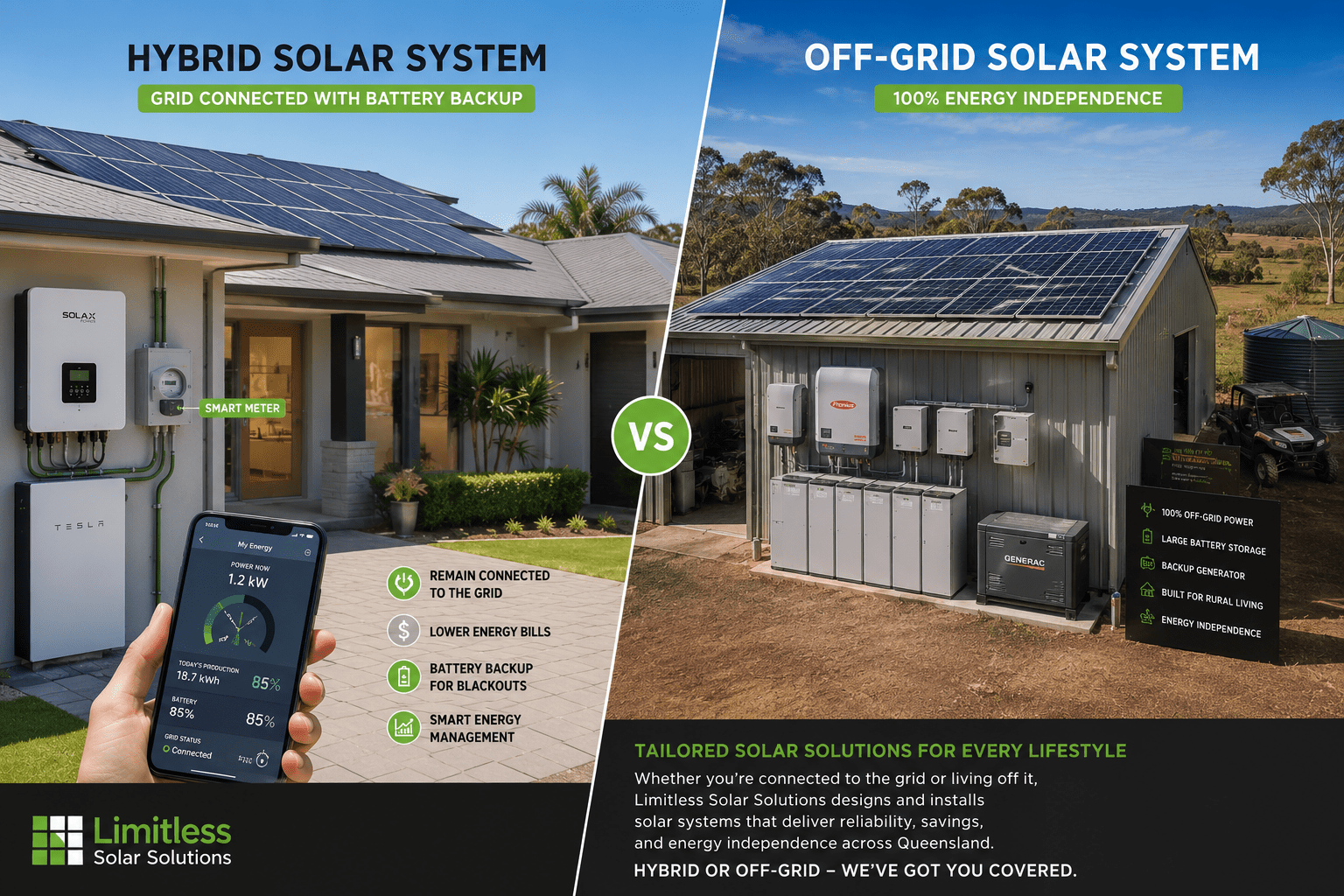
We will compare their costs, performance during blackouts, and suitability for different lifestyles. Let’s explore the right path for your energy future.
Jump to section
- Key Takeaways
- What Are Hybrid Solar Systems and How Do They Work?
- What Are Off-Grid Solar Systems and How Do They Deliver Energy Independence?
- Hybrid vs. Off-Grid Solar: A Detailed Comparison
- Designing Your Solar System: Key Considerations for Queensland Properties
- Choosing the Right Solar Partner: Why Limitless Solar Solutions?
- Empower Your Property with the Right Solar Setup
- Frequently Asked Questions
Key Takeaways
-
Hybrid solar balances grid connection with battery independence.
-
Off-grid solar offers total energy independence but requires a larger investment.
-
Choosing depends on location, budget, energy goals, and lifestyle.
-
Local expertise is crucial for optimal system design in Queensland.
What Are Hybrid Solar Systems and How Do They Work?
A hybrid solar system provides the best of both worlds by combining solar panels and battery storage with a connection to the main electricity grid. This setup gives you energy independence while keeping the grid as a reliable safety net. The system intelligently manages the flow of electricity, ensuring you use your solar power as efficiently as possible.
During the day, your solar panels generate electricity to power your home or business. Any extra energy produced is used to charge your solar battery. If the battery is full and you are still generating more power than you need, the surplus is exported to the grid, often earning you a credit on your electricity bill. In the evening or on cloudy days, your property first draws power from the battery, only turning to the grid when the battery is depleted.
Who Is a Hybrid Solar System Best Suited For in Queensland?
A hybrid solar system is an excellent choice for most homeowners and businesses on the Sunshine Coast and in North Brisbane who have a reliable grid connection. It is ideal for those looking to significantly reduce their electricity bills and gain protection against power outages without completely disconnecting. If you want more control over your energy usage and the ability to use your own solar power at night, a hybrid setup is perfect.
These systems are also well-suited for properties looking to manage energy costs through peak shaving, where the battery is used to avoid high-cost electricity during peak demand times. They are highly scalable, meaning you can easily add an EV charger or more battery capacity in the future. Limitless Solar Solutions designs and installs advanced hybrid solar systems tailored for South East Queensland conditions, recommending smart hybrid inverters that intelligently manage your energy flow for maximum benefit.
How Do Hybrid Systems Maximise Energy Efficiency and Savings?
Hybrid systems offer several ways to increase your energy efficiency and generate financial savings. They are designed to make the most of your solar investment by intelligently directing power where it is needed most, cutting your reliance on expensive grid electricity.
-
Self-Consumption: The primary financial benefit comes from storing the free solar energy you generate during the day for use at night. Instead of buying electricity from your retailer during expensive evening peak hours, you use the power stored in your battery. This directly lowers your quarterly power bills and protects you from rising energy prices.
-
Blackout Protection: When a grid outage occurs, a properly configured hybrid system automatically disconnects from the grid and powers your essential circuits. This Uninterruptible Power Supply (UPS) capability keeps your lights, fridge, and internet running. Limitless Solar Solutions‘ SAA-accredited electricians ensure your system provides seamless backup power when you need it most. This focused backup ensures critical systems remain operational, but properties needing to power their entire load during outages might find an off-grid system or a larger, dedicated battery backup more suitable.
-
Feed-in Tariffs (FiTs): While FiT rates for exporting surplus energy are declining, they still provide a small credit on your bill. Once your battery is full, any extra solar power is sent to the grid. The declining value of FiTs makes storing your own energy in a battery an even more logical financial decision.
-
Time-of-Use Optimisation: Modern hybrid systems can be programmed to take advantage of Time-of-Use electricity tariffs. They can charge the battery with cheap, off-peak grid power overnight and then use that stored energy during the more expensive peak periods. This strategy creates savings even on days with low solar generation.
What Are Off-Grid Solar Systems and How Do They Deliver Energy Independence?
An off-grid solar system, also known as a Stand-Alone Power System (SAPS), operates completely independently from the main electricity grid. It is a self-sufficient power station for your property, relying solely on solar energy, a large battery bank, and a backup generator. This setup means you no longer receive electricity bills and are completely immune to grid blackouts.
The system is designed to provide 100% of your property’s energy needs, 365 days a year, reflecting a growing body of research on Review on 100% Renewable energy system analyses. Solar panels generate power during the day to run your appliances and charge a high-capacity battery bank. This stored energy is then used to power your property overnight and during periods of poor weather. For guaranteed reliability, a backup generator is integrated to automatically take over and recharge the batteries during extended cloudy spells or when your energy demand is unusually high. While generators provide crucial backup, their operation involves fuel costs and periodic maintenance, a factor to consider in the long-term running of an off-grid property.
Is an Off-Grid System the Right Choice for Your Rural Property?
An off-grid solar system is the definitive option for properties in the Sunshine Coast Hinterland, on large acreage blocks, or in remote locations where connecting to the grid is either impossible or prohibitively expensive, as demonstrated by Resource assessment and techno-economic analyses of off-grid hybrid systems. If you have been quoted tens of thousands of dollars just to run power poles to your property, investing that money into an off-grid system offers an immediate return. It is also the ideal choice for anyone prioritising absolute energy independence and environmental sustainability.
This setup is perfect for sheds, cabins, farms, and eco-retreats that require a reliable, autonomous power supply. It allows you to live or operate a business without being tied to fluctuating electricity prices or an unreliable rural grid. Limitless Solar Solutions conducts detailed site assessments and energy audits to determine if an off-grid system is the right fit for you, with comprehensive residential systems starting from approximately $15,000.
What Are the Critical Components for a Reliable Off-Grid Setup?
A dependable off-grid system is built from robust, high-quality components engineered to work together seamlessly. Because there is no grid to fall back on, every part of the system must be correctly sized and installed to handle your property’s full energy demands in all conditions.
-
Solar Panels: A large array of high-yield solar panels is the foundation. The array must be sized not just for your average daily use but for the worst-case scenario. This means it needs to generate enough power to charge your batteries even during the shortest winter days.
-
High-Capacity Battery Bank: The battery is the heart of an off-grid system. It needs to be large enough to provide several “Days of Autonomy,” meaning it can power your property for multiple days without any solar input. Limitless Solar Solutions supplies premium lithium (LiFePO4) battery systems like the Tesla Powerwall 3 and Sungrow batteries for their safety and long lifespan.
-
Off-Grid Inverter/Charger: This powerful device is the brain of the system. It converts DC power from your batteries to AC power for your home, manages the charging from solar panels, and controls the backup generator. It creates the stable micro-grid that your property runs on.
-
Backup Generator: A generator is an essential safety net for any off-grid system. It ensures you have continuous power during long periods of bad weather or if you have an unexpected spike in energy use. Limitless Solar Solutions integrates auto-start generators that turn on and off automatically as needed.
Hybrid vs. Off-Grid Solar: A Detailed Comparison
Choosing between a hybrid vs off-grid solar system depends on your specific location, budget, and energy goals. While both use batteries to store solar power, their fundamental connection to the grid creates major differences in cost, reliability, and daily operation. Understanding these distinctions is key to making the right investment for your property.
A hybrid system offers a flexible balance, reducing bills and providing backup power while retaining the grid’s unlimited supply as a fallback. An off-grid system delivers complete freedom from power companies but requires a much larger upfront investment and more careful energy management. The following table provides a direct comparison of their key attributes.
| Feature | Hybrid Solar System | Off-Grid Solar System |
|---|---|---|
| Grid Connection | Yes, connected to the grid. | No, completely independent. |
| Upfront Cost | Moderate ($10,000 – $20,000). | High ($25,000 – $60,000+). |
| Ongoing Bills | Minimal daily supply charge. | Zero electricity bills. Generator fuel and maintenance costs. |
| Blackout Protection | Powers essential circuits. | Powers the entire property. Immune to grid failures. |
| Excess Energy | Exported to the grid for a Feed-in Tariff. | Curtailed (lost) once batteries are full. |
| System Sizing | Sized for average daily usage. | Sized for worst-case weather scenarios. |
| Best Suited For | Urban/suburban properties with grid access. | Rural/remote properties where grid connection is expensive or unavailable. |
| Scalability | Easy to expand with more batteries or EV chargers. | More complex to upgrade. |
Financial Considerations: Upfront Cost, ROI, and Rebates
The financial side of the hybrid vs off-grid solar debate is one of the most significant factors. Hybrid systems have a much lower barrier to entry, with a typical high-quality installation costing between $10,000 and $20,000, a finding consistent with Renewable Energy Use for residential off-grid building conversion case studies. Their return on investment (ROI) is achieved by reducing grid electricity purchases and earning small FiTs, with payback periods often falling between 5 to 9 years. Limitless Solar Solutions provides transparent, itemised quotes to help you understand the full cost.
Off-grid systems command a much higher upfront investment, often ranging from $25,000 to over $60,000 for a residential property. This is due to the need for larger battery banks, heavy-duty inverters, and a backup generator. The ROI for an off-grid system is calculated differently. If connecting your property to the grid costs $30,000 or more, an off-grid system provides an immediate return by avoiding that fee and eliminating all future power bills. For example, some power networks may quote upwards of $100,000 to run poles and wires to a rural block, making off-grid the only financially viable option.
Both system types are eligible for the federal government’s Small-scale Technology Certificates (STCs), which significantly reduces the initial cost. Limitless Solar Solutions helps customers access all available incentives, including federal and state battery rebates, to make the investment more manageable.
Navigating Energy Security and Blackout Protection
In South East Queensland, where summer storms can cause frequent power outages, energy security is a major consideration. A hybrid system provides reliable blackout protection by using its UPS capability to automatically isolate your home from the grid and switch to battery power. This keeps essential circuits like your fridge, lights, and modem running. However, its backup power is limited by the inverter’s output and battery size, so it may not run heavy loads like ducted air conditioning.
An off-grid system offers the ultimate level of energy security, a conclusion supported by IEEE research on Achieving a 100% Renewable grid and operating power systems with extremely high levels of variable renewable energy. Since it is designed for complete autonomy, it is entirely immune to grid blackouts and will continue to power your entire property without interruption. Limitless Solar Solutions designs off-grid systems with carefully sized battery banks and integrated backup generators to provide resilience during Queensland’s storm seasons. These systems are engineered with multiple “Days of Autonomy,” ensuring you have power even through several days of continuous rain or cloud cover. While hybrid systems are easier to scale, off-grid systems provide peace of mind that is second to none.
Designing Your Solar System: Key Considerations for Queensland Properties
A successful solar investment, whether hybrid or off-grid, starts with a thoughtful and precise design. Simply installing panels on a roof is not enough; the system must be tailored to your property’s specific energy needs, geographic location, and future goals. Key factors like system sizing and the integration of new technologies like electric vehicles play a huge part in performance and long-term value.
Getting the design right from the beginning ensures your system will perform optimally for decades. It prevents issues like under-production in winter or insufficient power for your peak loads. A professional design considers all variables to create a balanced, efficient, and cost-effective energy setup.
“The cheapest kilowatt-hour is the one you don’t use. A well-designed solar system not only generates power efficiently but also encourages mindful energy consumption.”
Why Accurate System Sizing is Crucial for Your Solar Investment
System sizing is the most important step in the design process. An undersized system will fail to meet your energy needs, leading to frustration and continued reliance on the grid or generator. An oversized system means you have over-invested in equipment you do not need, extending your payback period. Accurate sizing starts with detailed load profiling, which involves analysing your daily and peak electricity consumption.
Seasonal variations are also a major factor. Hybrid systems can be sized based on your annual average energy use, as the grid is always available for backup. However, off-grid systems must be sized for the worst-case scenario, ensuring they produce enough power during the shortest, cloudiest days of winter. Limitless Solar Solutions uses advanced tools and detailed energy analysis to create custom solar system designs that are perfectly matched to your consumption patterns and long-term goals.
Integrating Electric Vehicle (EV) Charging into Your Solar System
The rapid rise of electric vehicles is changing the way we think about home energy. Charging an EV can add 15-20 kWh to a household’s daily energy consumption, effectively doubling its load. This makes EV charging integration a key design consideration for any new solar system.
Hybrid systems are perfectly suited for EV charging. A smart EV charger like a Zappi or Wallbox can be programmed to use only surplus solar energy, meaning you can power your car for free. Limitless Solar Solutions recommends adding 2.5kW to 3kW of solar capacity for every 10,000 km you drive annually to cover this extra demand. For off-grid systems, charging an EV presents a bigger challenge. It requires a significant upsizing of the solar array and battery bank to avoid constant reliance on the backup generator, adding considerable cost to the project.
Choosing the Right Solar Partner: Why Limitless Solar Solutions?
Selecting the right solar installer is just as important as choosing the right system. Your solar partner should have deep local expertise, a commitment to quality components, and a focus on long-term customer support. A quality installation ensures your system performs efficiently, safely, and reliably for its entire lifespan.
Limitless Solar Solutions is a trusted local expert for hybrid and off-grid systems in Queensland. We pride ourselves on transparent service and tailored systems that meet the unique needs of each property. Our in-house team of accredited installers guarantees a high standard of workmanship on every project.
Our Tailored Approach to Hybrid and Off-Grid Systems in South East Queensland
We understand that a one-size-fits-all approach does not work for solar. Our process begins with a custom design based on a thorough site assessment, energy audit, and a discussion about your budget and future goals. We have extensive knowledge of Energex requirements, local building codes, and Queensland’s unique climate challenges, from extreme summer heat to cyclonic storm seasons.
We are brand-agnostic, meaning we recommend the best combination of reputable components for your specific needs, not just the products of a single manufacturer. We work with leading brands like Tesla Powerwall 3, Sungrow, and LG Energy Solutions to build reliable systems. Every installation is carried out by our own SAA-accredited, licensed electricians, ensuring full compliance with all Australian Standards and Queensland regulations.
How Does Limitless Solar Solutions Ensure Long-Term Value and Support?
Our commitment to you extends far beyond the installation day. We provide comprehensive support to ensure you get the most value from your investment for years to come. Our team guides you through the process of accessing all available STCs and government battery rebates, maximising your upfront savings.
We are experts in configuring hybrid systems for seamless blackout protection, giving you true peace of mind during grid failures. Our team is always available to help solve common challenges, such as planning for low-sunlight periods or assessing your system for future upgrades. We provide fully itemised quotes with clear warranty information, so you know exactly what you are getting, helping you avoid the pitfalls of cheap, low-quality systems.
Empower Your Property with the Right Solar Setup
The decision in the hybrid vs off-grid solar debate depends on your property’s location, your energy goals, and your budget. For most in urban and suburban areas, a hybrid system offers a smart, flexible, and financially sound path to lower bills and energy security. For those on rural or remote properties, an off-grid system delivers the ultimate prize of complete energy freedom.
Both paths lead to greater independence, reduced environmental impact, and protection from rising electricity costs. The key is to partner with an expert who can design the perfect system for your unique needs.
Contact Limitless Solar Solutions for a personalised consultation and take the first step towards your energy-independent future.
Frequently Asked Questions
Question: How do the ongoing maintenance requirements differ between hybrid and off-grid solar systems?
Answer: Hybrid systems require very little maintenance, mainly periodic panel cleaning and inverter checks. Off-grid systems need more attention, including regular servicing for the backup generator (fuel and oil) and more frequent monitoring of the larger battery bank, although modern LiFePO4 batteries are mostly maintenance-free.
Question: Can I convert my existing grid-connected solar system to a hybrid or off-grid setup?
Answer: Yes, most grid-tied systems can be retrofitted with a battery using an AC-coupled configuration to create a hybrid system. A full conversion to off-grid is more complex and may require significant upgrades to your existing components. Limitless Solar Solutions can assess your current setup to determine the best upgrade path.
Question: What happens to my hybrid solar system during a long-term grid outage or natural disaster?
Answer: During an outage, a hybrid system with blackout protection will power your essential circuits using stored battery and solar energy. If the outage lasts longer than your battery capacity and there is no sun to recharge it, the system will eventually run out of power, unlike an off-grid system with a generator.
Question: Are there specific challenges with off-grid solar in Queensland’s climate (e.g., extreme heat, storms)?
Answer: Yes. Extended cloudy periods during the wet season require larger battery banks and a reliable backup generator. High temperatures can also affect the performance of panels and batteries, so proper system design and ventilation are essential. Limitless Solar Solutions engineers systems specifically to handle these local conditions.
Question: How long do solar batteries typically last in hybrid and off-grid systems?
Answer: Modern lithium iron phosphate (LiFePO4) batteries installed by Limitless Solar Solutions typically last for 6,000 to over 10,000 charge cycles. This translates to a lifespan of 15-25 years of daily use. Most high-quality batteries come with a 10-year warranty guaranteeing a high percentage of their original capacity.
Question: What are “Virtual Power Plants (VPPs)” and can my solar system participate?
Answer: A VPP is a network of home batteries that energy retailers can draw power from during times of high grid demand. Owners of hybrid systems with compatible batteries can often join a VPP to earn extra income by selling their stored energy back to the grid when it is most needed.